
Initial US Approval
- 20241,2
Indications
Esophageal Cancer (1L and Previously Treated)
- In combination with platinum-containing chemotherapy for the first-line treatment of adults with unresectable or metastatic esophageal squamous cell carcinoma (ESCC) whose tumors express PD-L1 (≥ 1).1
- As a single agent in adults with unresectable or metastatic ESCC after prior systemic chemotherapy that did not include a PD-(L)1 inhibitor.1
Gastric Cancer (1L)
- In combination with platinum- and fluoropyrimidine-based chemotherapy in adults for the first-line treatment of unresectable or metastatic HER2-negative (HER2–) gastric or gastroesophageal junction (GEJ) adenocarcinoma whose tumors express PD-L1 (≥ 1).1
Recommended Dose/Route
- Tislelizumab, 200 mg, as an intravenous infusion once every 3 weeks. Administer the first infusion over 60 minutes. If tolerated, subsequent infusions may be administered over 30 minutes.1
Dose Reductions for Adverse Reactions
- No dose reduction of tislelizumab is recommended.1
- In general, withhold tislelizumab for severe (grade 3), immune-mediated adverse reactions.1
- Permanently discontinue tislelizumab for life-threatening (grade 4), immune-mediated adverse reactions; recurrent, severe (grade 3), immune-mediated reactions that require systemic immunosuppressive treatment; or an inability to reduce corticosteroid dose to 10 mg or less of prednisone equivalent per day within 12 weeks of initiating steroids1
Pivotal Study
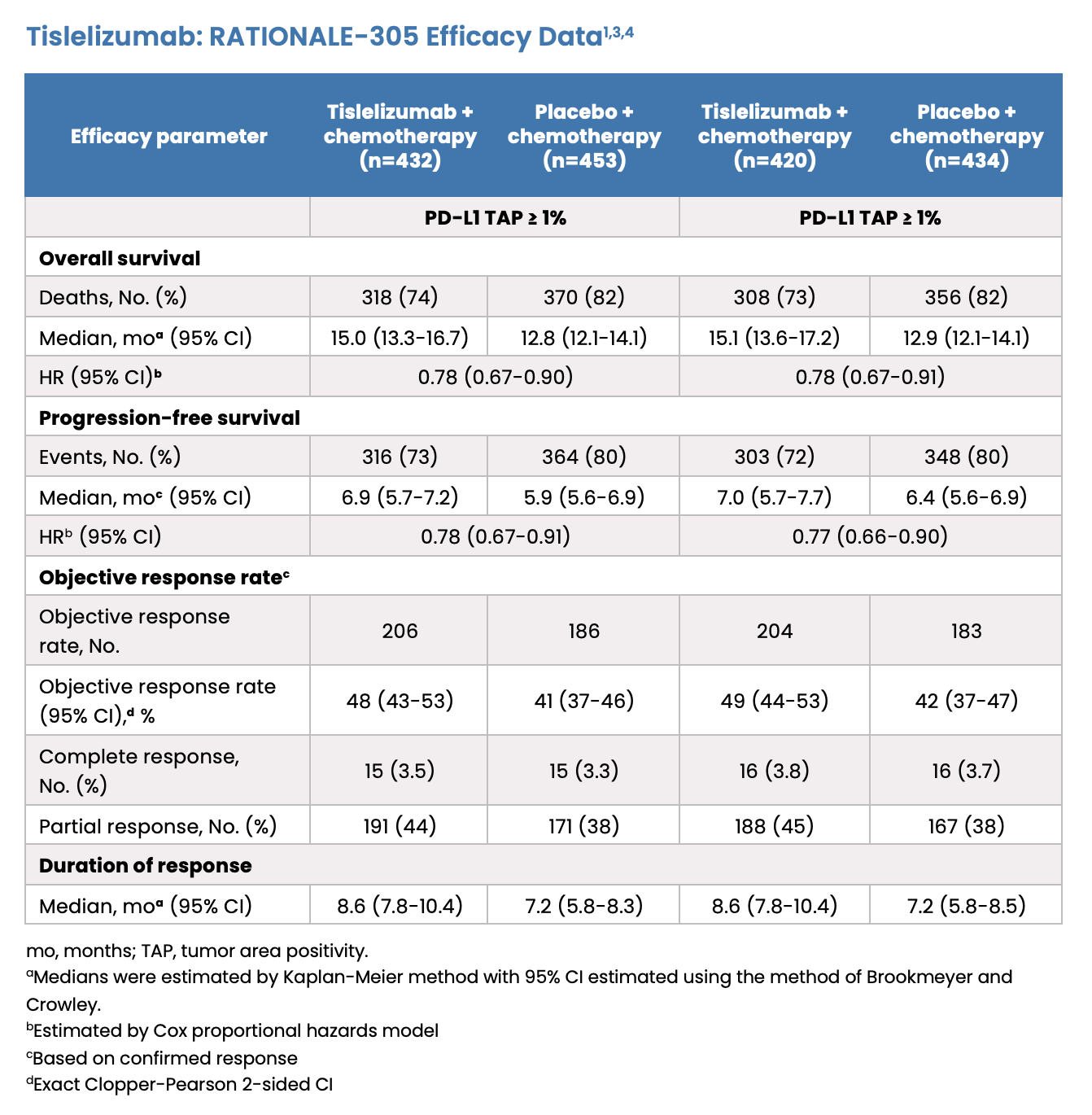
RATIONALE-305 (NCT03777657)1,3,4
- Key inclusion criteria: Histologically confirmed gastric cancer or GEJ cancer, HER2–, and no previous therapy for unresectable, locally advanced, or metastatic gastric cancer/GEJ.
- Treatment: Tislelizumab, 200 mg, every 3 weeks in combination with chemotherapy (investigator’s choice of either oxaliplatin-capecitabine or cisplatin-fluorouracil on a 21-day cycle) until disease progression or unacceptable toxicity occurs.
Safety
RATIONALE-3051,3,4
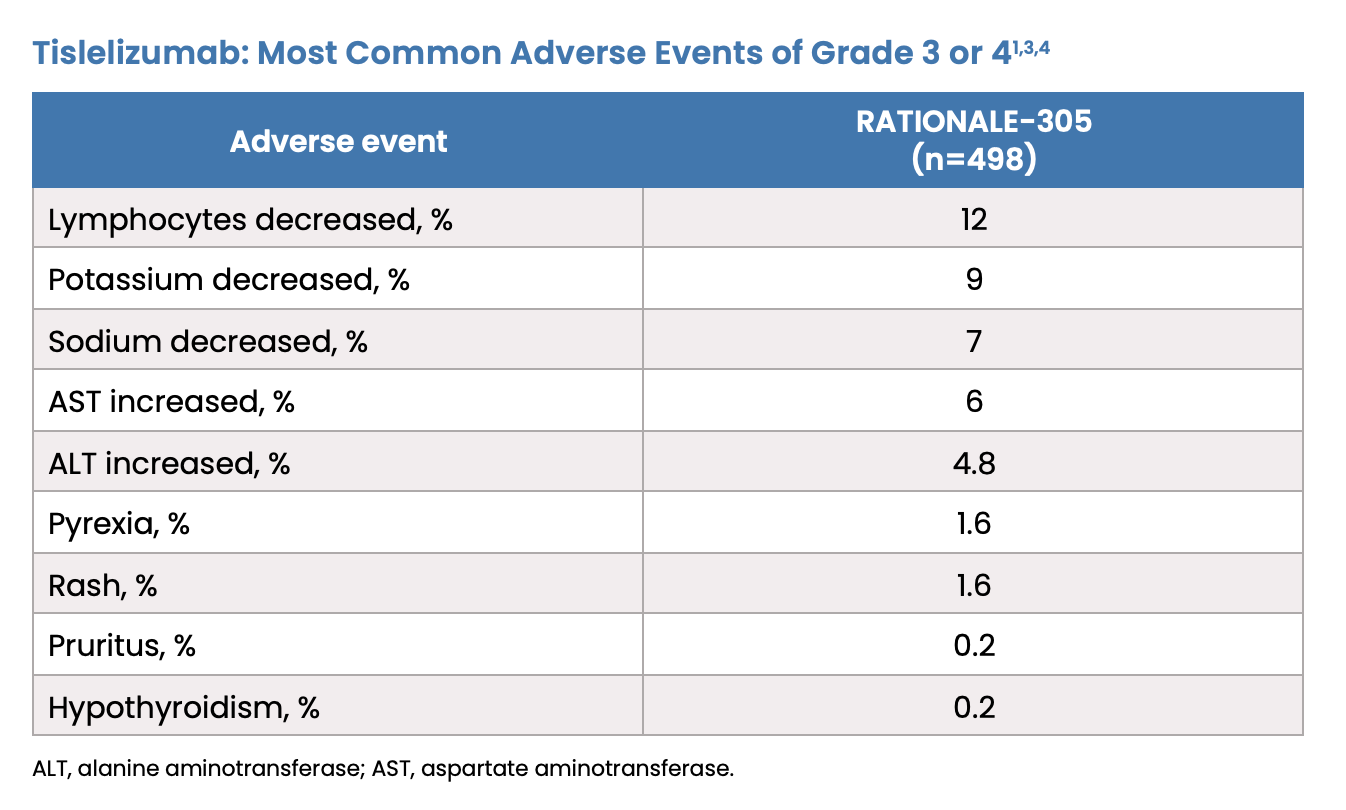
- Common adverse events (AEs) (≥ 10%): The most frequently reported any grade adverse events (AEs) were pyrexia (20%), rash (16%), hypothyroidism (13%), and pruritus (10%).
- Common laboratory abnormalities (≥ 10%): The most frequently reported laboratory abnormalities of any grade were aspartate aminotransferase increased (58%), lymphocytes increased (53%), sodium decreased (42%), alanine aminotransferase increased (41%), and potassium decreased (33%).
- Dosage interruption due to AEs: 49%
- Permanent discontinuation due to AEs: 16%
References
- Tevimbra. Prescribing information. BeiGene USA; 2025. Accessed March 3, 2025. https://www.beigene.com/PDF/TEVIMBRAUSPI.pdf
- TEVIMBRA approved in U.S. for first-line treatment of gastric and gastroesophageal junction cancers in combination with chemotherapy. Press release. BeiGene. December 27, 2024. Accessed March 18, 2025. https://ir.beigene.com/news/tevimbra-approved-in-u-s-for-first-line-treatment-of-gastric-and-gastroesophageal-junction-cancers-in-combination/cedb475b-fcfe-47a4-8afe-8a501d9cf849/
- Qiu MZ, Oh DY, Kato K, et al. Tislelizumab plus chemotherapy versus placebo plus chemotherapy as first line treatment for advanced gastric or gastro-oesophageal junction adenocarcinoma: RATIONALE-305 randomised, double blind, phase 3 trial. BMJ. 2024;385:e078876. doi:10.1136/bmj-2023-078876
- Moehler M, Kato K, Arkenau T, et al. RATIONALE-305: phase 3 study of tislelizumab plus chemotherapy vs placebo plus chemotherapy as first-line treatment (1L) of advanced gastric or gastroesophageal junction adenocarcinoma (GC/GEJC). J Clin Oncol. 2023;41(4; suppl):286. doi:10.1200/JCO.2023.41.4_suppl.286