
NTRK
- Neurotrophic tropomyosin kinase receptors (NTRK)
NTRK Biology
- Neurotrophic tropomyosin kinase receptors (NTRK) are transmembrane kinases involved in neural cells’ development, proliferation, and survival.1-3
- After localization to cell membranes, the protein family is activated by nerve growth factor (NGF) ligands, brain-derived neurotrophic factor (BDNF), neurotrophin-3 (NT-3), NT-4, and NT-5.1,3,4
- The TRK family consists of 3 members, including TKRA, TKRB, and TRKC and activation of these proteins leads to downstream activation of the signal pathways RAS-RAF-MEK-ERK, phosphatidylinositol-3 (PI3) kinase, and phospholipase C gamma (PLC-γ).3,4
Etiology and Epidemiology
- NTRK genes are proto-oncogenes that activate into oncogenic driver mutations via gene fusions that lead to chimeric TRK proteins.1,3,4
- The prevalence of NTRK gene fusions is approximately 1% in solid tumors, but there is a lack of data regarding the prevalence in gastroesophageal cancer.1
- NTRK gene fusions occur through chromosome rearrangements, point mutations, deletions, or gene fusions and cause spontaneous ligand-independent dimerization.3
- These chimeric proteins have constitutive TRK protein activity or overexpression of the kinase function.4
- Current research suggests that oncogenic mutations cause a change exclusively in the extracellular domain of chimeric proteins, suggesting a common regulatory domain.3
Testing for NTRK Gene Fusions
When to Test:
- Patients with gastric cancer should undergo testing for NTRK gene fusions and other relevant biomarkers at the time of diagnosis using next-generation sequencing (NGS) at the discretion of the physician.5
Available Testing Methods:
- Feasible testing methods include immunohistochemistry (ICH), fluorescence in situ hybridization (FISH), DNA-based next-generation sequencing, and RNA-based NGS.2,4
- The ideal approach appears to be RNA-based NGS because of the higher rates of false positives and lack of evidence of functional transcription present in other methods.1,5
Guideline Recommendations for Testing:
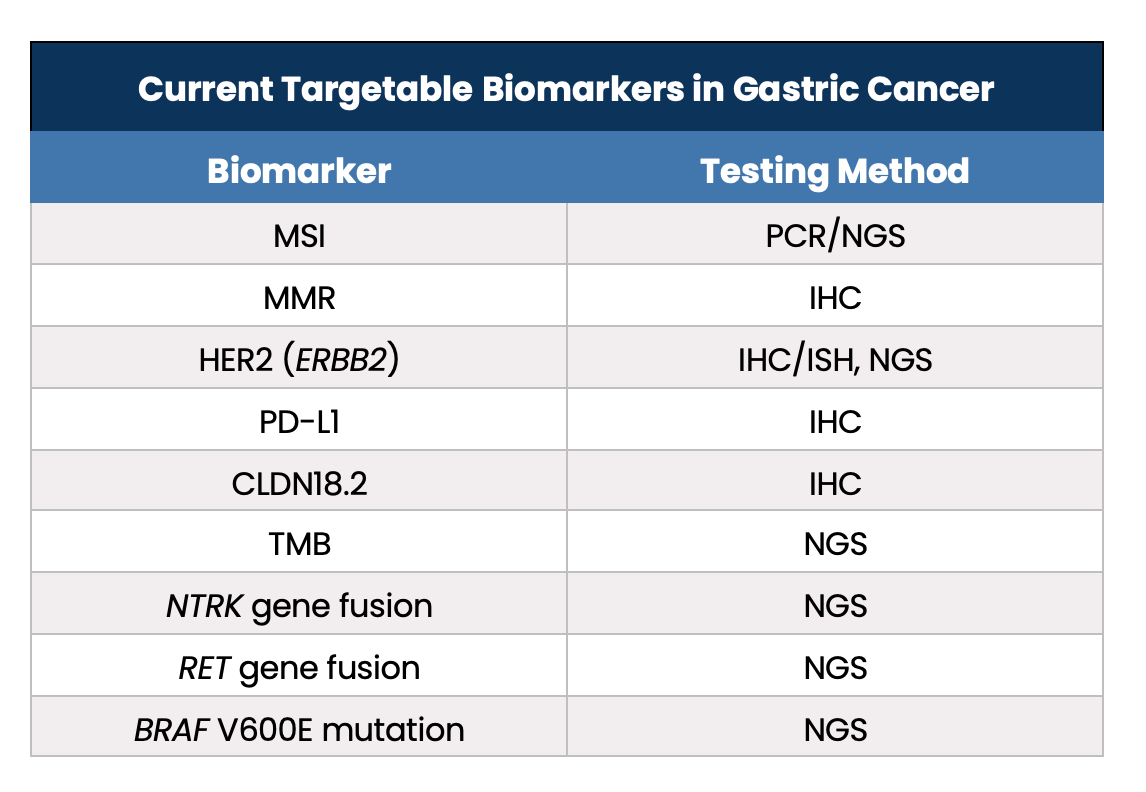
- Biomarker testing for gastric cancer should start with IHC and targeted PCR, followed by NGS testing.5
- If tissue is limited or a biopsy isn't feasible, sequential single biomarker testing may deplete the sample. In these cases, comprehensive genomic profiling via a validated NGS assay is advised.5
- Key biomarkers for interrogation include HER2 overexpression, PD-L1 expression, microsatellite instability, tumor mutational burden, NTRK fusion, RET fusion, and BRAF V600E mutation.5
NTRK-Targeted Therapy
Approved Agents:
- Currently, 2 FDA-approved options exist for treating unresectable or metastatic NTRK gene fusion–positive solid tumors.5-7
- Larotrectinib and entrectinib are recommended as second- or subsequent-line treatments in NTRK+ patients. Their favorable safety profile and clinically meaningful response support regular screening for gene fusions.5-7
- Approval for larotrectinib was based on the data from 3 trials, LOCO-TRK-14001 (NCT02122913), SCOUT (NCT02637687), and NAVIGATE (NCT02576431).5,7,8 The overall response rate in 55 patients was 75% (95% CI, 61-85), 71% of responses remained ongoing at 1 year, and 55% remained progression-free at 1 year.5,7,8
- Entrectinib approval was based on data from the trials STARTRK-2 (NCT02568267) and STARTRK-1 (NCT02097810), and ALKA-372-001.5,6,9 The study population comprised 54 adults with an overall response rate of 57% (95% CI, 43-71), progression-free survival 11.2 months (95% CI, 8.0-14.9), and overall survival 20.9 (95% CI, 14.9-NR).5,7,9
Entrectinib6
- FDA-Approved Indication:
- The FDA has approved entrectinib for the treatment of adult and pediatric patients 12 years of age and older with solid tumors that have a neurotrophic receptor tyrosine kinase (NTRK) gene fusion without a known acquired resistance mutation, are metastatic, or where surgical resection is likely to result in severe morbidity; it is also approved for situations where there are no satisfactory alternative treatments or the patient has progressed following treatment.
- This indication has received accelerated approval based on the overall response rate and duration of response. Continued approval for this indication may be contingent upon verification and description of clinical benefit in confirmatory trials.
- Mechanism of Action:
- Entrectinib is an inhibitor of the tropomyosin receptor tyrosine kinases (TRK) TRKA, TRKB, and TRKC (encoded by the neurotrophic tyrosine receptor kinase [NTRK] genes NTRK1, NTRK2, and NTRK3, respectively), proto-oncogene tyrosine-protein kinase ROS1 (ROS1), and anaplastic lymphoma kinase (ALK). Entrectinib also inhibits JAK2 and TNK2.
- Fusion proteins that include TRK, ROS1, or ALK kinase domains can drive tumorigenic potential through hyperactivation of downstream signaling pathways leading to unconstrained cell proliferation. Entrectinib demonstrated in vitro and in vivo inhibition of cancer cell lines derived from multiple tumor types harboring NTRK, ROS1, and ALK fusion genes.
- Drug Information:
- Patient Resources:
Larotrectinib7
- FDA-Approved Indication:
- The FDA has approved larotrectinib for the treatment of adult and pediatric patients with solid tumors that have a neurotrophic receptor tyrosine kinase (NTRK) gene fusion without a known acquired resistance mutation, are metastatic, or where surgical resection is likely to result in severe morbidity; it is also approved for situations where there are no satisfactory alternative treatments or the patient has progressed following treatment.
- This indication has received accelerated approval based on the overall response rate and duration of response. Continued approval for this indication may be contingent upon verification and description of clinical benefit in confirmatory trials.
- Mechanism of Action:
- Larotrectinib is an inhibitor of the tropomyosin receptor kinases (TRK), TRKA, TRKB, and TRKC. TRKA, B, and C are encoded by the genes NTRK1, NTRK2, and NTRK3.
- Chromosomal rearrangements involving in-frame fusions of these genes with various partners can result in constitutively-activated chimeric TRK fusion proteins that can act as an oncogenic driver, promoting cell proliferation and survival in tumor cell lines. In in vitro and in vivo tumor models, larotrectinib demonstrated anti-tumor activity in cells with constitutive activation of TRK proteins resulting from gene fusions, deletion of a protein regulatory domain, or in cells with TRK protein overexpression.
- Drug Information:
- Patient Resources:
References
- Manea CA, Badiu DC, Ploscaru IC, et al. A review of NTRK fusions in cancer. Annals of Medicine & Surgery. 2022;79:103893. doi:10.1016/j.amsu.2022.103893
- Solomon JP, Hechtman JF. Detection of NTRK fusions: merits and limitations of current diagnostic platforms. Cancer Res. 2019;79(13):3163-3168. doi:10.1158/0008-5472.CAN-19-0372
- Lange A, Lo HW. Inhibiting TRK proteins in clinical cancer therapy. Cancers. 2018;10(4):105. doi:10.3390/cancers10040105
- Arnold A, Daum S, Von Winterfeld M, et al. Analysis of NTRK expression in gastric and esophageal adenocarcinoma (AGE) with pan-TRK immunohistochemistry. Pathology - Research and Practice. 2019;215(11):152662. doi:10.1016/j.prp.2019.152662
- National Comprehensive Cancer Network. NCCN guidelines version 1.2024: gastric cancer. May 29, 2024. Accessed May 5, 2024. https://www.nccn.org/professionals/physician_gls/pdf/gastric.pdf
- ROZLYTREK (entrectinib). Prescribing information. Genentech; 2019. Accessed May 5, 2024. https://www.gene.com/download/pdf/rozlytrek_prescribing.pdf
- VITRAKVI (larotrectinib). Prescribing information. Loxo Oncology; 2018. Accessed May 5, 2024. https://labeling.bayerhealthcare.com/html/products/pi/vitrakvi_PI.pdf
- Drilon A, Laetsch TW, Kummar S, et al. Efficacy of larotrectinib in TRK fusion-positive cancers in adults and children. N Engl J Med. 2018;378(8):731-739. doi:10.1056/NEJMoa1714448
- Demetri GD, Paz-Ares L, Farago AF, et al. Efficacy and safety of entrectinib in patients with NTRK fusion-positive (NTRK-fp) tumors: pooled analysis of STARTRK-2, STARTRK-1 and ALKA-372-001. Ann Oncol. 2018;29(suppl 8):viii713. doi:10.1093/annonc/mdy424.017