
Initial US Approval
- 20111
Indications
Metastatic ROS1/ALK+ NSCLC:
- The treatment of adult patients with metastatic non-small cell lung cancer (NSCLC) whose tumors are anaplastic lymphoma kinase (ALK) or ROS1-positive as detected by an FDA-approved test.
Relapsed or Refractory ALK+ ALCL:
- The treatment of pediatric patients 1 year of age and older and young adults with relapsed or refractory, systemic anaplastic large cell lymphoma (ALCL) that is ALK-positive.
- Limitations of Use: The safety and efficacy of crizotinib have not been established in older adults with relapsed or refractory, systemic ALK-positive ALCL.
ALK+ IMT:
- The treatment of adult and pediatric patients 1 year of age and older with unresectable, recurrent, or refractory inflammatory myofibroblastic tumor (IMT) that is ALK-positive.
Recommended Dose/Route
- Crizotinib 250 mg orally, twice daily, with or without food1
Dose Reductions for Adverse Reactions
- 1st reduction: 200 mg twice daily1
- 2nd reduction: 250 mg once daily1
Pivotal Study
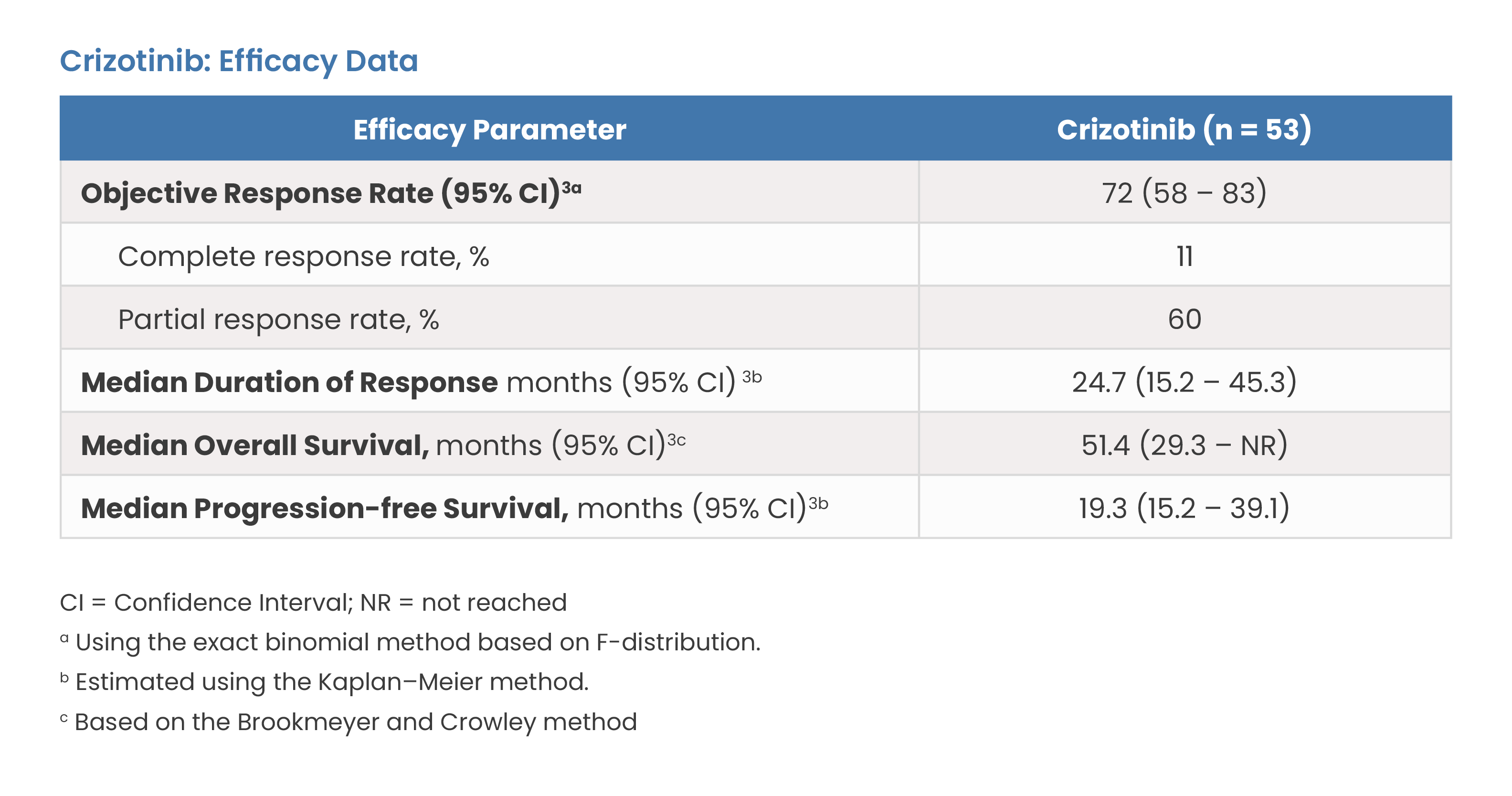
PROFILE 1001 (NCT00585195)2,3
- Key Inclusion Criteria: Eligible patients were required to have advanced NSCLC with a ROS1 rearrangement identified by fluorescence in situ hybridization (FISH) or reverse-transcriptase–polymerase-chain reaction (RT-PCR) assay, an Eastern Cooperative Oncology Group Performance Status (ECOG PS) of 0 to 2, adequate organ function, and measurable disease according to the Response Evaluation Criteria in Solid Tumors version 1.0 (RECIST v1.0).2
- Treatment: Crizotinib 250 mg orally twice daily until disease progression, unacceptable toxicity, withdrawal from the study, or death.2
Safety
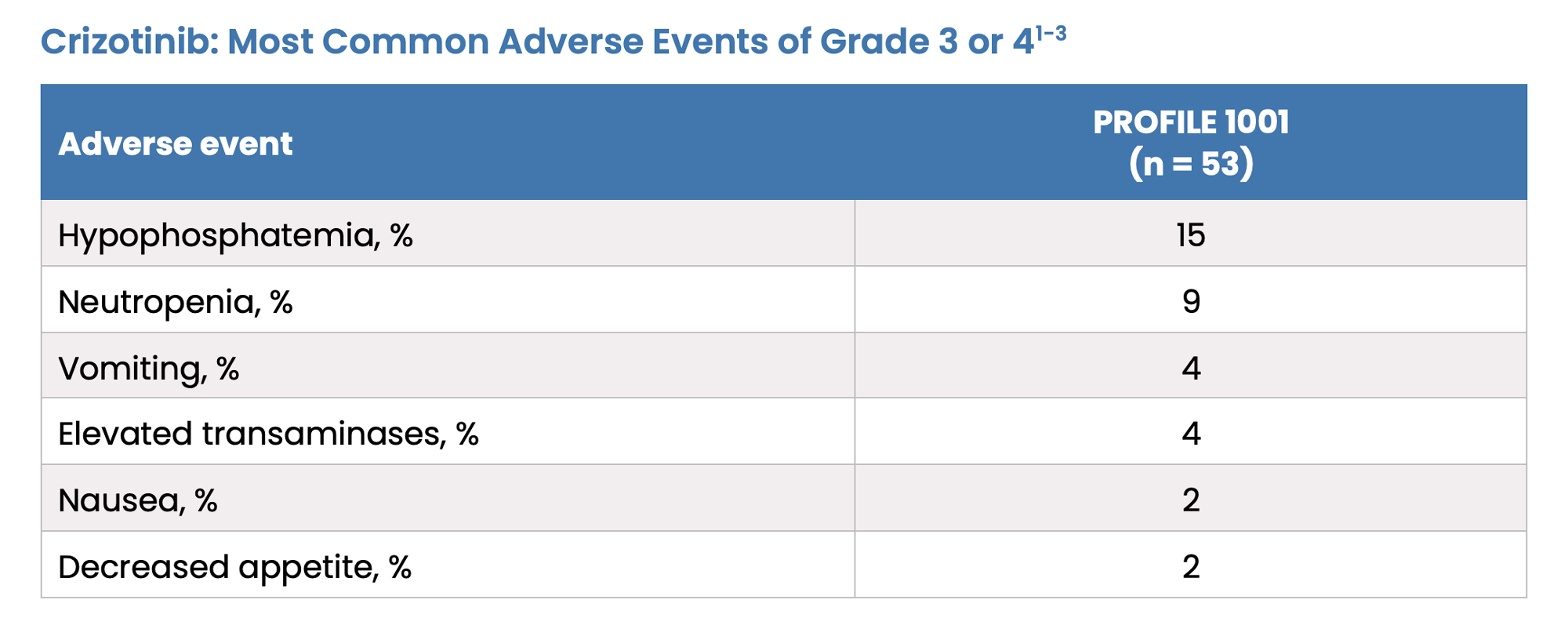
PROFILE 10012,3
- Common Adverse Reactions (≥20%): The most frequently reported any grade AEs were vision disorder (87%), nausea (51%), edema (47%), diarrhea (45%), vomiting (38%), elevated transaminases (36%), and constipation (34%).1,3
- Common Laboratory Abnormalities: The most common Grade 3 or 4 laboratory abnormalities (≥15%) included neutropenia, lymphopenia, and thrombocytopenia. Grade 4 laboratory abnormalities (≥15%) included neutropenia (62%), lymphopenia (35%), and thrombocytopenia (19%).1,3
- Dosage Interruption Due to AEs: 77%1,3
- Dosage Reductions Due to AEs: 19%1,3
References
- XALKORI (crizotinib). Prescribing information. Pfizer Inc.; 2023. Accessed December 10, 2024. https://labeling.pfizer.com/ShowLabeling.aspx?id=676
- Shaw AT, Ou SH, Bang YJ, et al. Crizotinib in ROS1-rearranged non-small-cell lung cancer. N Engl J Med.2014;371(21):1963-71.
- Shaw AT, Riely GJ, Bang YJ, et al. Crizotinib in ROS1-rearranged advanced non-small-cell lung cancer (NSCLC): updated results, including overall survival, from PROFILE 1001. Ann Oncol. 2019;30(7):1121-1126.
- Zhou F, Yang Y, Zhang L, et al. Expert consensus of management of adverse drug reactions with anaplastic lymphoma kinase tyrosine kinase inhibitors. ESMO Open. 2023;8(3):101560. doi:10.1016/j.esmoop.2023.101560
- Cappuzzo F, Moro-Sibilot D, Gautschi O, et al. Management of crizotinib therapy for ALK-rearranged non-small cell lung carcinoma: An expert consensus. Lung Cancer. 2015;87(2):89-95. doi:10.1016/j.lungcan.2014.12.010