
Initial US Approval
- 20221
Indications
Locally Advanced or Metastatic KRAS G12C-Mutated NSCLC*:
- As a single agent, for the treatment of adult patients with KRAS G12C-mutated locally advanced or metastatic non small cell lung cancer (NSCLC), as determined by an FDA-approved test, who have received at least one prior systemic therapy.1
Locally Advanced or Metastatic KRAS G12C-Mutated CRC*:
- In combination with cetuximab, for the treatment of adult patients with KRAS G12C mutated locally advanced or metastatic colorectal cancer (CRC), as determined by an FDA-approved test, who have received prior treatment with fluoropyrimidine-, oxaliplatin-, and irinotecan-based chemotherapy.1
*These indications are approved under accelerated approval based on objective response rate (ORR) and duration of response (DOR). Continued approval for these indications may be contingent upon verification and description of a clinical benefit in confirmatory trials.1
Recommended Dose/Route
- Adagrasib 600 mg orally twice daily, with or without food1
Dose Reductions for Adverse Reactions
- 1st reduction: 400 mg twice daily1
- 2nd reduction: 600 mg once daily1
Pivotal Study
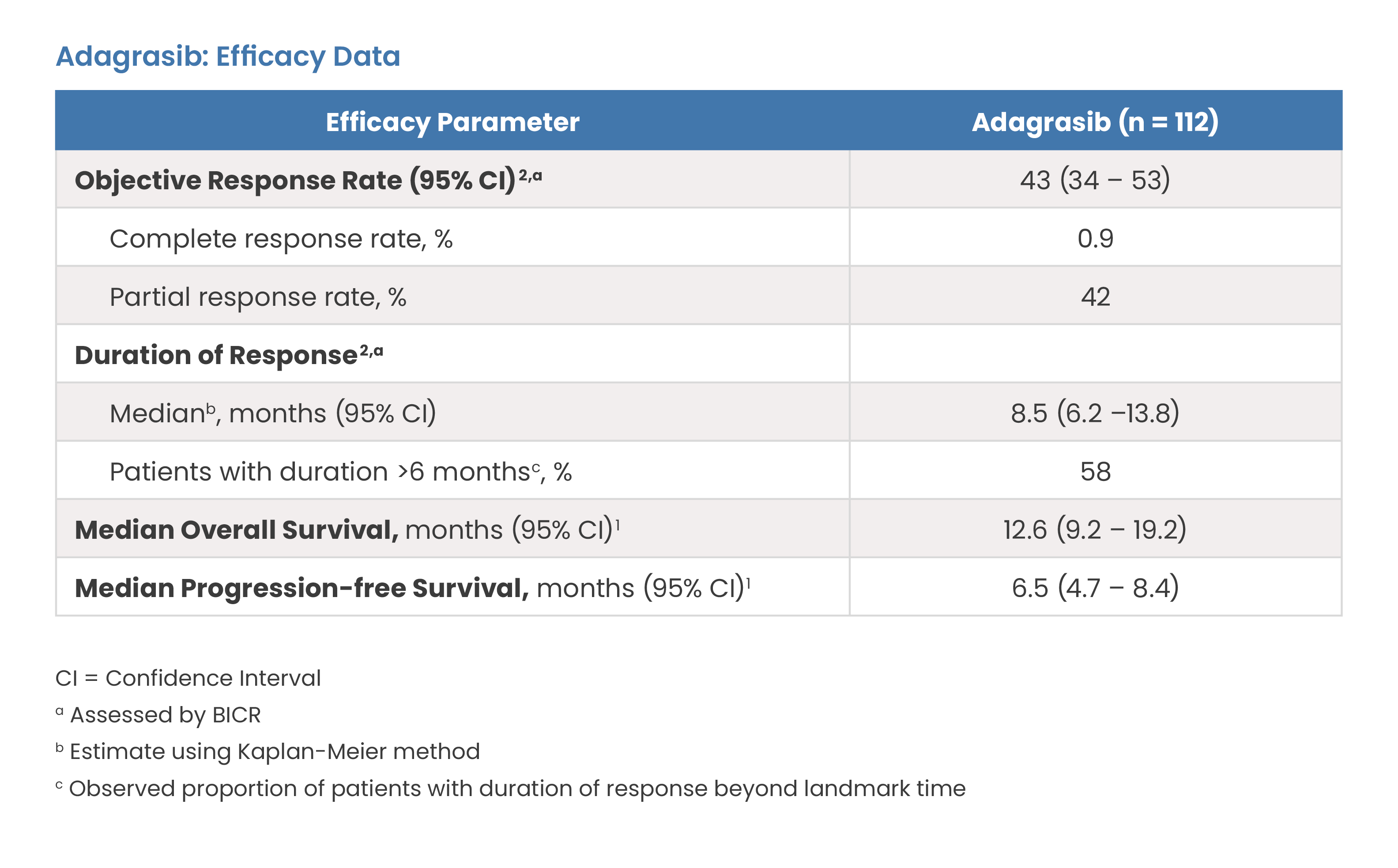
KRYSTAL-1 (NCT03785249)2
Locally Advanced or Metastatic KRAS G12C-Mutated NSCLC
- Key Inclusion Criteria: Eligible patients were required to have locally advanced or metastatic KRAS G12C-mutated NSCLC who previously received treatment with a platinum-based regimen and an immune checkpoint inhibitor, an Eastern Cooperative Oncology Group Performance Status (ECOG PS) of 0 or 1, and at least one measurable lesion as defined by Response Evaluation criteria in Solid Tumors (RECIST v1.1).1
- Treatment: Adagrasib 600 mg orally twice daily until unacceptable toxicity or disease progression.1
Safety
KRYSTAL-12
Locally Advanced or Metastatic KRAS G12C-Mutated NSCLC
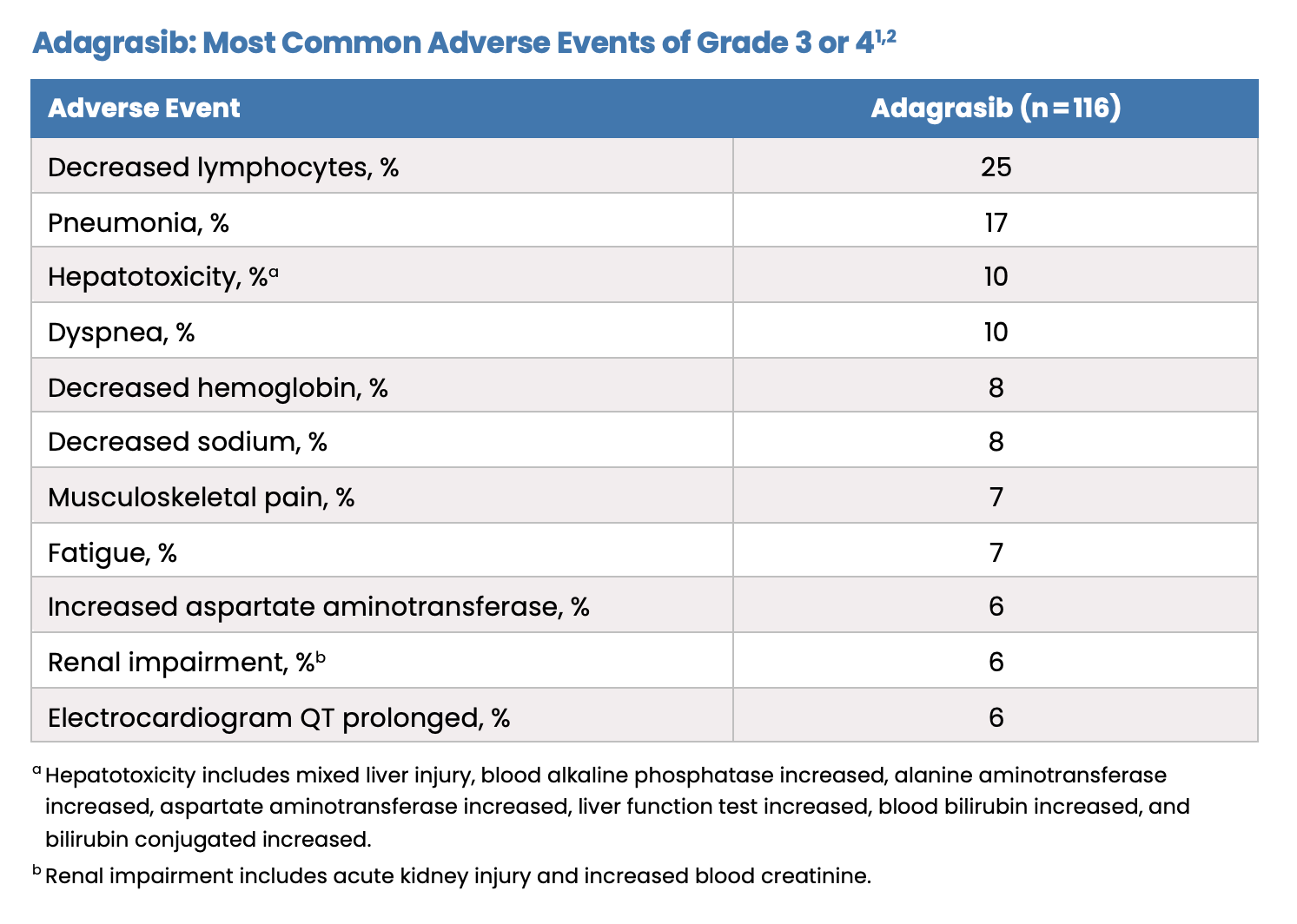
- Common adverse reactions (≥20%): The most frequently reported any grade AEs were diarrhea (70%), nausea (69%), fatigue (59%), vomiting (56%), musculoskeletal pain (41%), hepatotoxicity (37%), renal impairment (36%), dyspnea (35%), edema (32%), decreased appetite (30%), cough (24%), pneumonia (24%), dizziness (23%), constipation (22%), abdominal pain (21%), and QTc interval prolongation (20%).1
- Common laboratory abnormalities (≥25%): The most frequently reported laboratory abnormalities were decreased lymphocytes (64%), increased aspartate aminotransferase (52%), decreased sodium (52%), decreased hemoglobin (51%), increased creatinine (50%), decreased albumin (50%), increased alanine aminotransferase (46%), increased lipase (35%), decreased platelets (27%), decreased magnesium (26%), and decreased potassium (26%).1
- Dosage Interruption Due to Adverse Events (AEs): 77%1
- Dosage Reductions Due to AEs: 28%1
- Permanent Discontinuation Due to AEs: 13%1
References
- KRAZAT (adagrasib). Prescribing information. Mirati Therapeutics; December 2022. https://packageinserts.bms.com/pi/pi_krazati.pdf
- Jänne PA, Riely GJ, Gadgeel SM, et al. Adagrasib in non–small-cell lung cancer harboring a KRASG12C mutation. N Engl J Med. 2022; 387:120-131. doi:10.1056/NEJMoa2204619
- Zhang J, Johnson M, Barve M, et al. Practical guidance for the management of adverse events in patients with KRASG12C-mutated non-small cell lung cancer receiving adagrasib. Oncologist. 2023;28(4):287-296. doi:10.1093/oncolo/oyad051.