
Initial US Approval
- 20141
Indications
- The treatment of adult and pediatric patients with unresectable or metastatic microsatellite instability-high (MSI-H) or mismatch repair–deficient (dMMR) solid tumors as determined by an FDA-approved test who have experienced progression following prior treatment and who have no satisfactory alternative treatment options. (Abbreviated indication, see full prescribing information for additional information)
Recommended Dose/Route (MSI-H or dMMRmCRC)
- Pembrolizumab200 mg every 3 weeks or 400 mg every 6 weeks; until disease progression, unacceptable toxicity, or up to 24 months.1
Dose Reductions for Adverse Reactions
- No dose reductions are recommended. Withhold or discontinue pembrolizumab to manage adverse reactions.1
Pivotal Studies
- KEYNOTE-177 (NCT02563002)2
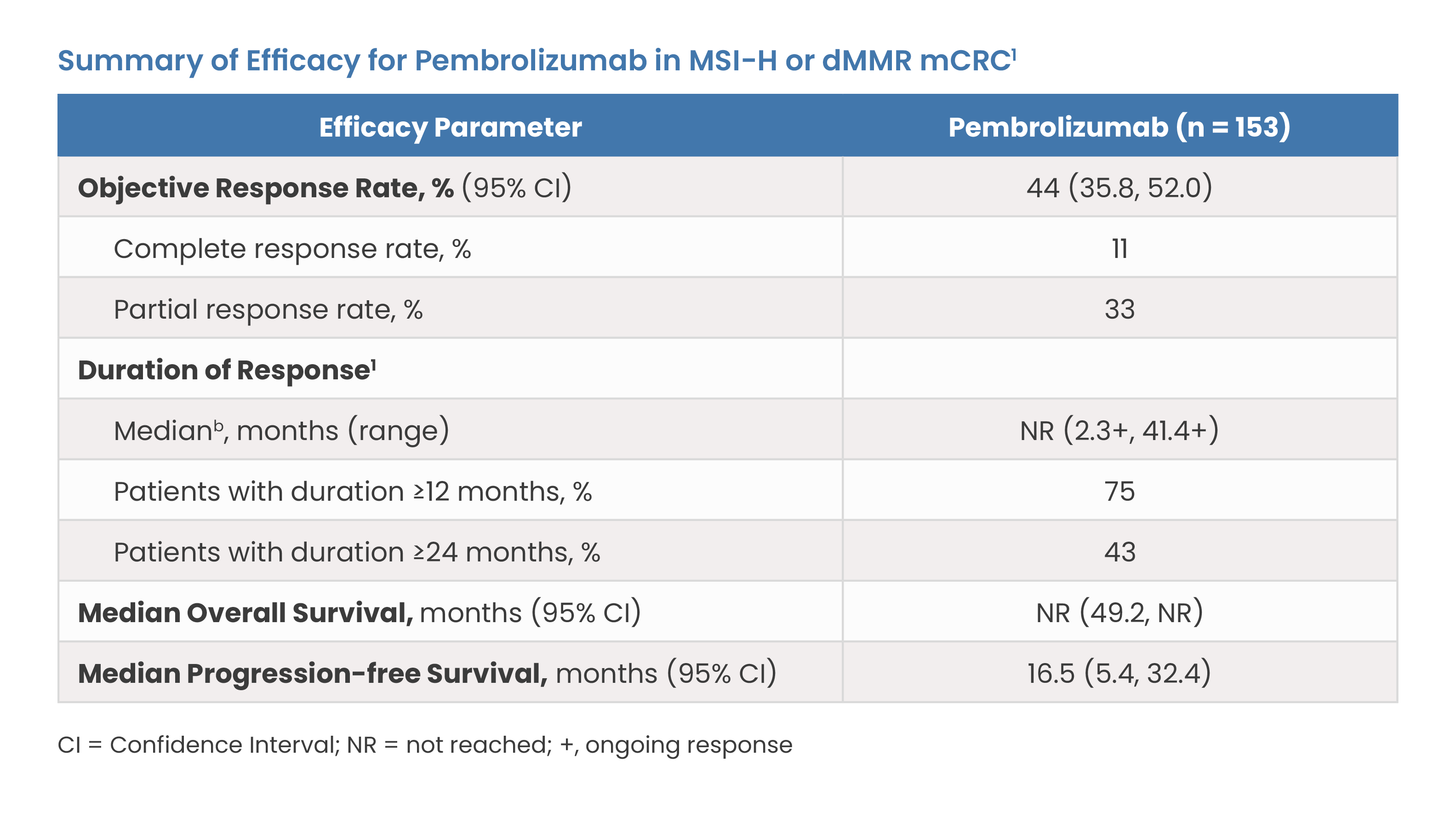
- Key Inclusion Criteria: A total of 307 patients with previously untreated unresectable or metastatic MSI-H or dMMR CRC.1
- Treatment: Pembrolizumab 200 mg intravenously every 3 weeks or investigator’s choice of the following chemotherapy regimens given intravenously every 2 weeks.1
Safety
- The most common any grade adverse events in patients receiving pembrolizumab included diarrhea, fatigue, nausea, abdominal pain, decreased appetite and vomiting. Immune-mediated adverse events and infusion reactions occurred in 31% of patients.2,3
- Permanent Discontinuation Due to AEs: 10%2,3
References
- KEYTRUDA (pembrolizumab). Prescribing information. Merck & Co., Inc.; December 2018. https://www.merck.com/product/usa/pi_circulars/k/keytruda/keytruda_pi.pdf
- Diaz LA Jr, Shiu KK, Kim TW, et al. Pembrolizumab versus chemotherapy for microsatellite instability-high or mismatch repair-deficient metastatic colorectal cancer (KEYNOTE-177): final analysis of a randomised, open-label, phase 3 study. Lancet Oncol. 2022;23(5):659-670. doi: 10.1016/S1470-2045(22)00197-8.
- André T, Shiu KK, Kim TW, et al. Pembrolizumab in microsatellite-instability-high advanced colorectal cancer. N Engl J Med. 2020;383(23):2207-2218. doi: 10.1056/NEJMoa2017699.