Brand: Trodelvy
Initial US Approval
- 20201
- Breast cancer indications expanded in April 2021 (regular approval, pretreated TNBC), February 2023 (HR-positive/HER2-negative), and June 24, 2026 (two first-line TNBC indications).1,2
Indications
- As a single agent for the first-line treatment of adults with unresectable locally advanced or metastatic triple-negative breast cancer (TNBC) who are not candidates for PD-1 or PD-L1 inhibitor-based therapy.1,2
- In combination with pembrolizumab, or pembrolizumab and berahyaluronidase alfa-pmph, for the first-line treatment of adults with unresectable locally advanced or metastatic TNBC whose tumors express PD-L1 (CPS greater than or equal to 10) as determined by an FDA-authorized test.1,2
- For adults with unresectable locally advanced or metastatic TNBC who have received two or more prior systemic therapies, at least one of them for metastatic disease.1
- For adults with unresectable locally advanced or metastatic HR-positive, HER2-negative (IHC 0, IHC 1+, or IHC 2+/ISH-negative) breast cancer who have received endocrine-based therapy and at least two additional systemic therapies in the metastatic setting.1
- No TROP2 assay is required. For the combination indication only, select patients based on tumor PD-L1 expression confirmed by an FDA-authorized test.1,2
Recommended Dose/Route
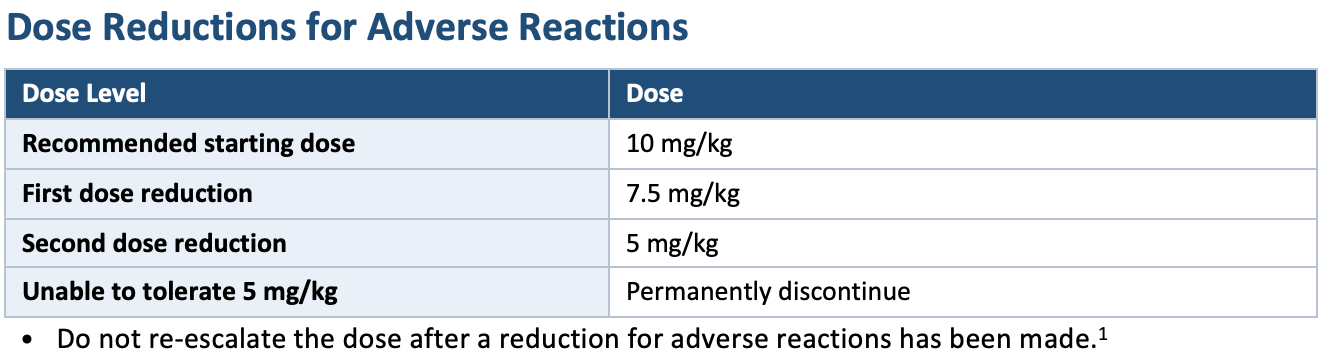
- 10 mg/kg by intravenous infusion on Days 1 and 8 of each 21-day cycle, until disease progression or unacceptable toxicity. Do not administer at doses greater than 10 mg/kg.1
- First infusion over 3 hours; subsequent infusions over 1 to 2 hours if prior infusions were tolerated. Observe patients during the infusion and for at least 30 minutes after completion.1
- Premedicate before each dose for infusion reactions (antipyretics, H1 and H2 blockers) and for chemotherapy-induced nausea and vomiting (a two- or three-drug antiemetic regimen). Primary G-CSF prophylaxis is recommended from the first cycle in all patients at increased risk of febrile neutropenia.1
- Do not substitute TRODELVY for, or use with, other drugs containing irinotecan or its active metabolite SN-38. When given in combination, discontinue pembrolizumab after approximately 24 months.1
Pivotal Study
ASCENT-03 (NCT05382299)
- Key Inclusion Criteria: 558 patients with unresectable locally advanced or metastatic TNBC untreated for advanced disease and not candidates for PD-1/PD-L1 inhibitors, defined as PD-L1 negative by CPS below 10, or CPS 10 or higher with prior neoadjuvant or adjuvant checkpoint therapy or a comorbidity precluding it.1
- Treatment: Randomized 1:1 to sacituzumab govitecan 10 mg/kg (n=279) or treatment of physician's choice (n=279).1
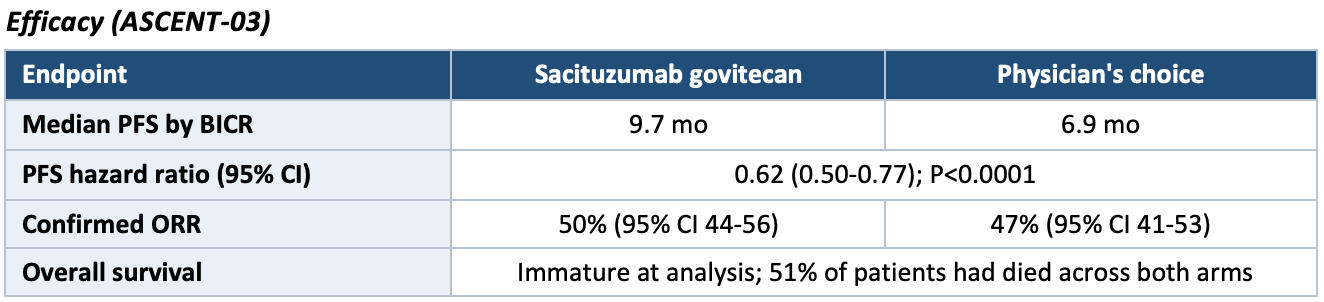
- Other registrational settings: ASCENT-04/KEYNOTE-D19 (with pembrolizumab, CPS 10 or higher, n=443) showed median PFS of 11.2 versus 7.8 months (HR 0.65; P=0.0009) and confirmed ORR 61% versus 55%, with overall survival also immature (46% deaths). ASCENT (2L+ TNBC, all randomized patients) showed median PFS of 4.8 versus 1.7 months (HR 0.43) and median OS of 11.8 versus 6.9 months (HR 0.51). TROPiCS-02 (HR-positive/HER2-negative) showed median PFS of 5.5 versus 4.0 months (HR 0.66) and median OS of 14.4 versus 11.2 months (HR 0.79; P=0.0200).1
- Analysis note: overall survival was immature in both 2026 first-line trials and neither supports an overall survival claim. The ASCENT figures above are the label's all-randomized-patient analysis; the frequently quoted 5.6 versus 1.7 months and 12.1 versus 6.7 months come from the brain-metastasis-negative population in the publication and must not be mixed with the label hazard ratios.1,3
Safety
ASCENT-03 (N=275)
- Summary: Serious adverse reactions occurred in 26% of patients, those above 2% being diarrhea, febrile neutropenia, and neutropenia (3.6% each) and pneumonia (2.9%). Fatal adverse reactions occurred in 2.5%, including sepsis (1.1%). Permanent discontinuation occurred in 3.6%, dosage interruption in 66%, and dose reduction in 37%. Median duration of treatment was 8.3 months.1
- Key warnings: across the pooled single-agent population, neutropenia occurred in 64% of patients (Grade 3-4 in 48%, febrile neutropenia in 6%) and diarrhea in 62% (Grade 3-4 in 10%). Patients homozygous for the UGT1A1*28 allele had a 57% incidence of Grade 3-4 neutropenia versus 41% in wild-type patients. Hypersensitivity and infusion-related reactions, nausea and vomiting, and embryo-fetal toxicity also apply.1
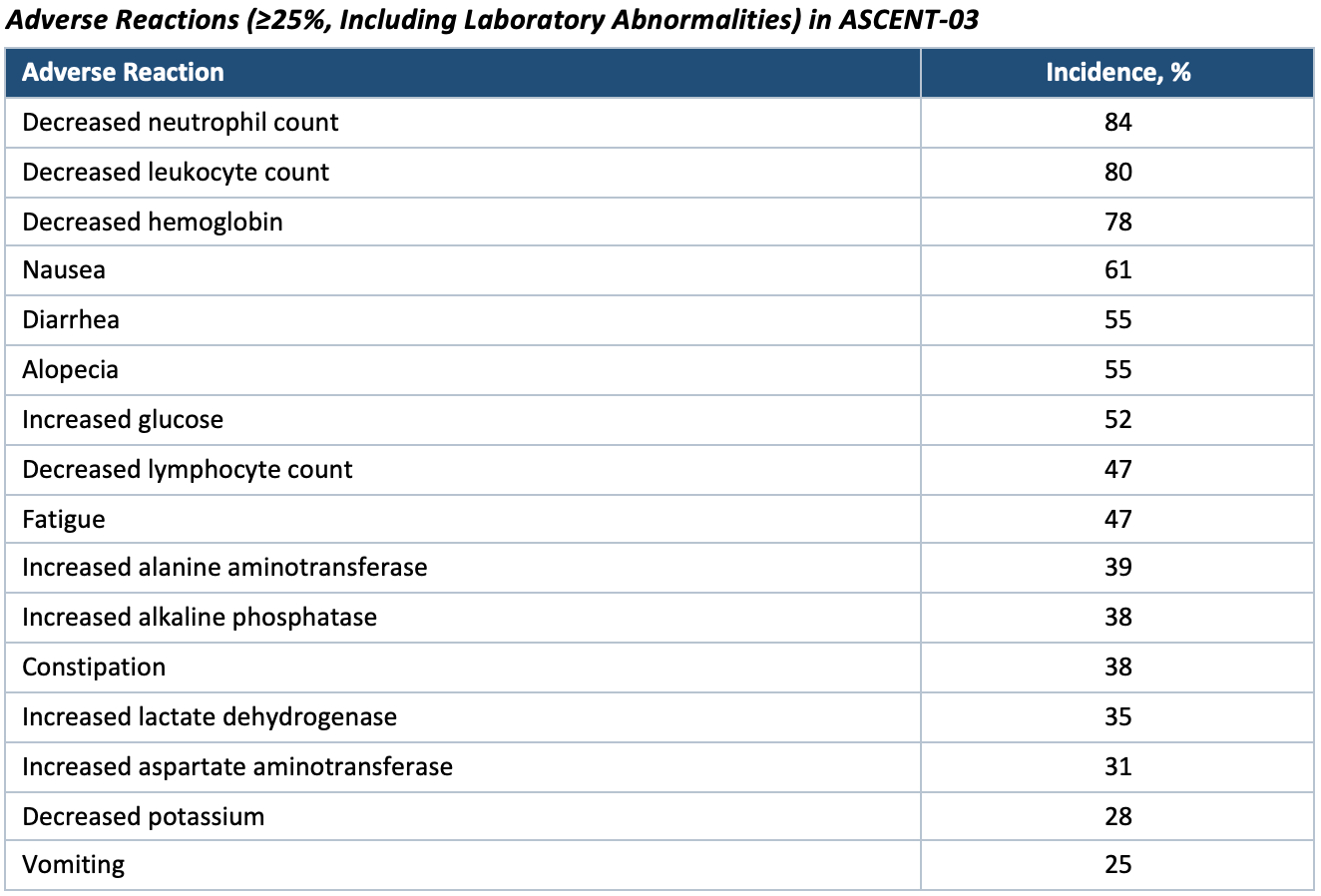
- Combination setting: in ASCENT-04 (N=221, with pembrolizumab), serious adverse reactions occurred in 38% and fatal adverse reactions in 3.2%. The most common reactions at 25% or higher were decreased neutrophil count and decreased hemoglobin (86% each), decreased leukocyte count (84%), diarrhea (72%), and nausea (68%). Do not substitute monotherapy rates for the combination regimen.1
References
1. TRODELVY (sacituzumab govitecan-hziy) for injection. Prescribing information. Gilead Sciences, Inc; revised 06/2026. Accessed July 2026.
2. US Food and Drug Administration. FDA approves sacituzumab govitecan-hziy as monotherapy and in combination with pembrolizumab for first-line treatment of triple-negative breast cancer. June 24, 2026. Accessed July 2026.
3. Bardia A, Hurvitz SA, Tolaney SM, et al. Sacituzumab govitecan in metastatic triple-negative breast cancer (ASCENT). N Engl J Med. 2021;384(16):1529-1541. doi:10.1056/NEJMoa2028485