Brand: Datroway
Initial US Approval
- 20251
- First approved January 17, 2025 for pretreated HR-positive/HER2-negative breast cancer, with the first-line TNBC indication added May 22, 2026.2,3
Indications
- For the treatment of adults with unresectable or metastatic triple-negative breast cancer (TNBC) who are not candidates for PD-1/PD-L1 inhibitor therapy.1,3
- For the treatment of adults with unresectable or metastatic hormone receptor-positive, HER2-negative (IHC 0, IHC 1+, or IHC 2+/ISH-negative) breast cancer who have received prior endocrine-based therapy and chemotherapy for unresectable or metastatic disease.1,2
- No TROP2 assay and no companion diagnostic are required for either breast cancer indication.1
Recommended Dose/Route
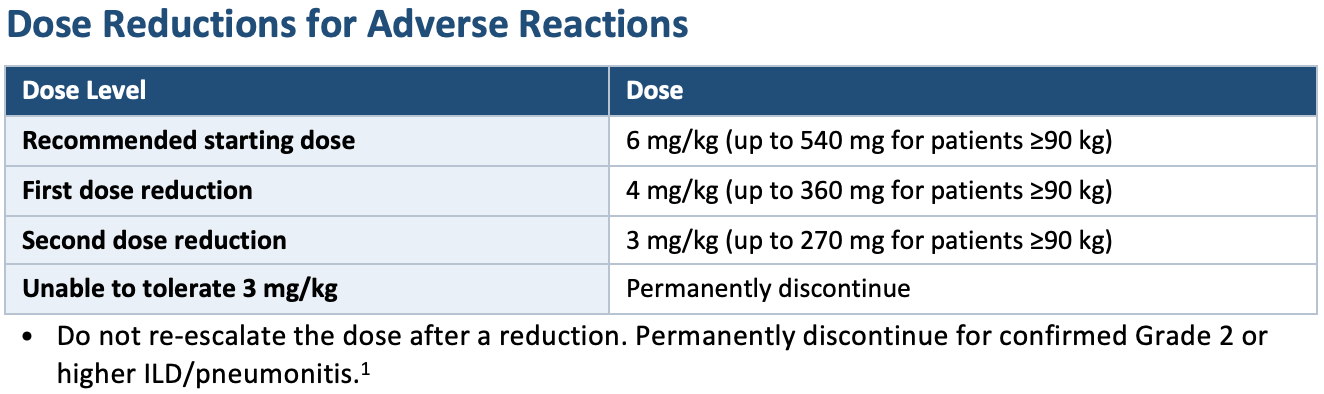
- 6 mg/kg (up to a maximum of 540 mg for patients weighing 90 kg or more) by intravenous infusion once every 3 weeks, until disease progression or unacceptable toxicity.1
- First infusion over 90 minutes; second infusion over 30 minutes if the first was tolerated; subsequent infusions over 30 minutes. Monitor for at least 1 hour for the first 2 cycles, then at least 30 minutes if no infusion-related reactions have occurred.1
- Required premedication and eye care: preservative-free lubricant eye drops at least four times daily; a steroid-containing mouthwash (dexamethasone oral solution 0.1 mg/mL) four times daily; an antihistamine and an antipyretic 30 to 60 minutes before each infusion; and an antiemetic before each infusion. Instruct patients to hold ice chips or ice water in the mouth throughout the infusion.1
- Conduct an ophthalmic exam at initiation, at end of treatment, and as clinically indicated, with visual acuity testing and slit lamp examination every 3 cycles while on treatment.1
- Reconstitute with Sterile Water for Injection and dilute in 5% Dextrose Injection. Do NOT use Sodium Chloride Injection.1
Pivotal Study
TROPION-Breast02 (NCT05374512)
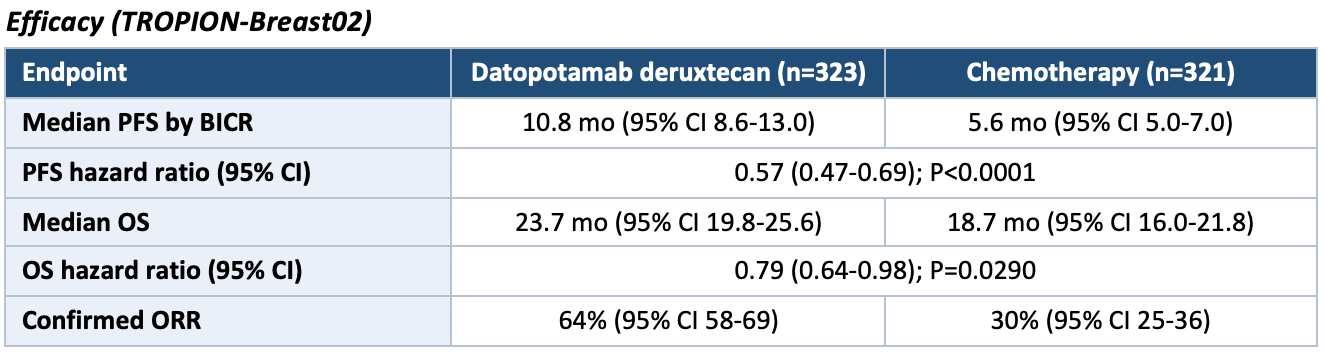
- Key Inclusion Criteria: 644 patients with unresectable or metastatic TNBC who had not received prior chemotherapy or other systemic anticancer therapy for advanced disease and who were not candidates for PD-1/PD-L1 inhibitor therapy. Patients with known germline BRCA pathogenic variants were enrolled only if ineligible for PARP inhibitor therapy. Patients with a history of ILD/pneumonitis requiring steroids, ongoing ILD/pneumonitis, or clinically significant corneal disease were excluded.1
- Treatment: Randomized 1:1 to datopotamab deruxtecan 6 mg/kg every 3 weeks (n=323) or investigator's choice of chemotherapy (n=321; nab-paclitaxel 54%, paclitaxel 28%, eribulin 11%, carboplatin 4.7%, capecitabine 2.2%).1
- Other registrational setting: TROPION-Breast01 (HR-positive/HER2-negative, pretreated; n=365 vs 367) showed median PFS of 6.9 versus 4.9 months (HR 0.63; P<0.0001) and confirmed ORR of 36% versus 23%. Overall survival was NOT improved (18.6 versus 18.3 months; HR 1.01), making this the first full FDA approval in breast cancer of an agent that did not improve overall survival in its registrational trial. Any efficacy slide covering the HR-positive/HER2-negative setting must state the negative overall survival result alongside the progression-free survival result, and must not conflate it with the positive TROPION-Breast02 result.1,4
Safety
TROPION-Breast02 (N=319)
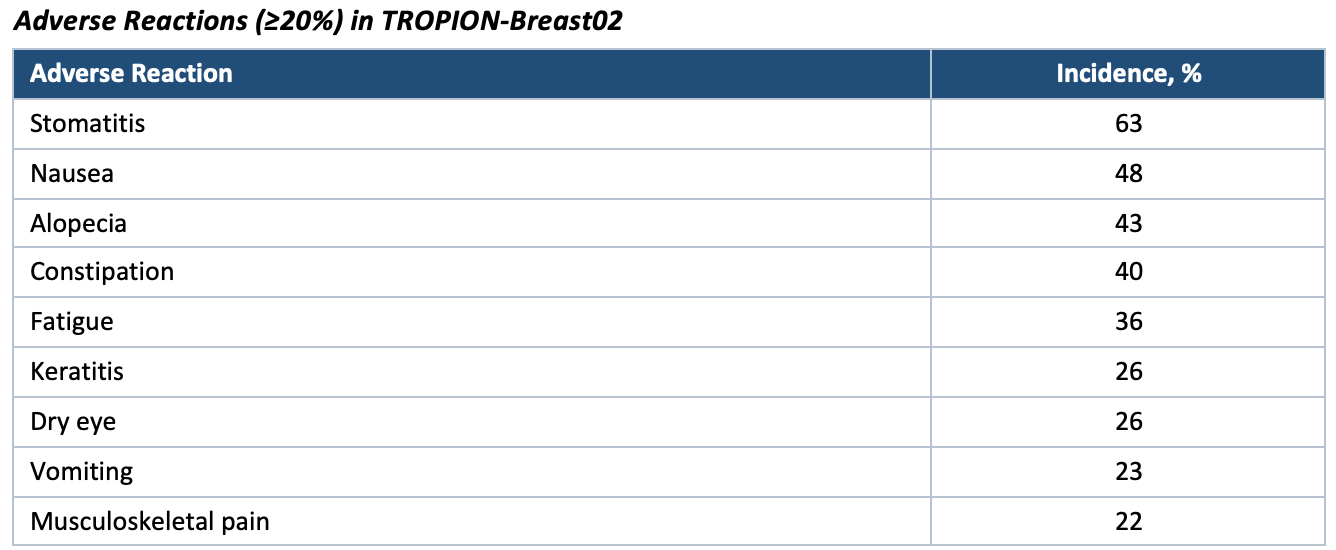
- Summary: Serious adverse reactions occurred in 17% of patients, those above 1% being pneumonia (2.2%), vomiting (1.9%), COVID-19 (1.6%), and anemia (1.3%). One fatal adverse reaction occurred (0.3%), due to ILD/pneumonitis. Permanent discontinuation occurred in 4.7%, dosage interruption in 35%, and dose reduction in 28%. Median duration of treatment was 8.5 months.1
- Key warning, stomatitis: stomatitis is the dominant toxicity across both breast trials. In the pooled safety population it occurred in 63% of patients (Grade 3 in 8%), led to dose reduction in 11% and permanent discontinuation in 0.4%, with a median time to first onset of 0.5 months. Prophylactic corticosteroid mouthwash and intra-infusion ice chips are label-directed mitigations.1
- Laboratory abnormalities (≥20%): increased amylase (54%), decreased hemoglobin (43%), decreased white blood cells (41%), decreased calcium (39%), decreased lymphocytes (36%), decreased neutrophils (35%), increased ALT (28%), increased AST (27%), decreased albumin (25%), decreased sodium (21%), and increased alkaline phosphatase (20%). Increased amylase was Grade 3 or 4 in 38% of patients, by far the highest-grade laboratory abnormality in this trial; any safety slide for the TNBC setting should carry it.1
- Other setting: in TROPION-Breast01 (N=360), serious adverse reactions occurred in 15%, fatal reactions in 0.3% (ILD/pneumonitis), permanent discontinuation in 3.1%, interruption in 22%, and reduction in 23%. The most common reactions at 20% or higher were stomatitis (59%), nausea (56%), fatigue (44%), alopecia (38%), constipation (34%), dry eye (27%), vomiting (24%), and keratitis (24%).1
References
1. DATROWAY (datopotamab deruxtecan-dlnk) for injection. Prescribing information. Daiichi Sankyo, Inc; revised 05/2026. Accessed July 2026.
2. US Food and Drug Administration. FDA approves datopotamab deruxtecan-dlnk for unresectable or metastatic, HR-positive, HER2-negative breast cancer. January 17, 2025. Accessed July 2026.
3. US Food and Drug Administration. FDA approves datopotamab deruxtecan-dlnk for unresectable or metastatic triple-negative breast cancer. May 22, 2026. Accessed July 2026.
4. Orlandi A. FDA and EMA approval of datopotamab-deruxtecan: a paradigm shift in breast cancer drug evaluation? The Breast. 2025. doi:10.1016/j.breast.2025.104589