Initial US Approval
- 20171
Indications
- In combination with an aromatase inhibitor as initial endocrine-based therapy, or with fulvestrant as initial endocrine-based therapy or following disease progression on endocrine therapy, for adults with HR-positive, HER2-negative advanced or metastatic breast cancer.1
- In combination with an aromatase inhibitor for the adjuvant treatment of adults with HR-positive, HER2-negative stage II or III early breast cancer at high risk of recurrence.1
Recommended Dose/Route
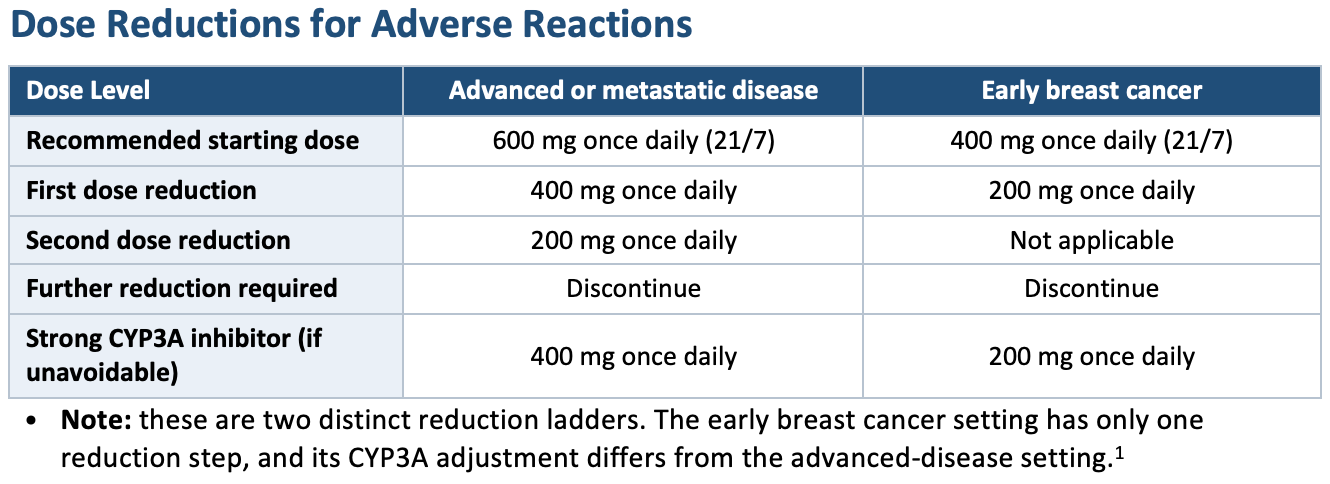
- Advanced or metastatic disease: 600 mg (three 200 mg tablets) orally once daily for 21 consecutive days followed by 7 days off, comprising a 28-day cycle, with or without food, plus endocrine therapy.1
- Early breast cancer: 400 mg (two 200 mg tablets) once daily on the same 21/7 schedule with an aromatase inhibitor, for 3 years or until recurrence or unacceptable toxicity.1
- Perform an ECG and assess electrolytes before initiation. Do not start if QTcF is 450 msec or greater. Repeat ECG at approximately Day 14 of Cycle 1, at the start of Cycle 2, and as clinically indicated. Correct hypokalemia and hypomagnesemia before and during treatment.1
- Pre- and perimenopausal women and men should also receive an LHRH agonist. Avoid concomitant tamoxifen, which carries additive QTc risk, and avoid strong CYP3A inhibitors and inducers.1
Pivotal Study
MONALEESA-2 (NCT01958021)
- Key Inclusion Criteria: Postmenopausal women with HR-positive/HER2-negative advanced or metastatic breast cancer and no prior systemic therapy for advanced disease.1,2
- Treatment: 668 patients randomized to ribociclib 600 mg (21/7) plus letrozole 2.5 mg daily or placebo plus letrozole (n=334 per arm).1,2
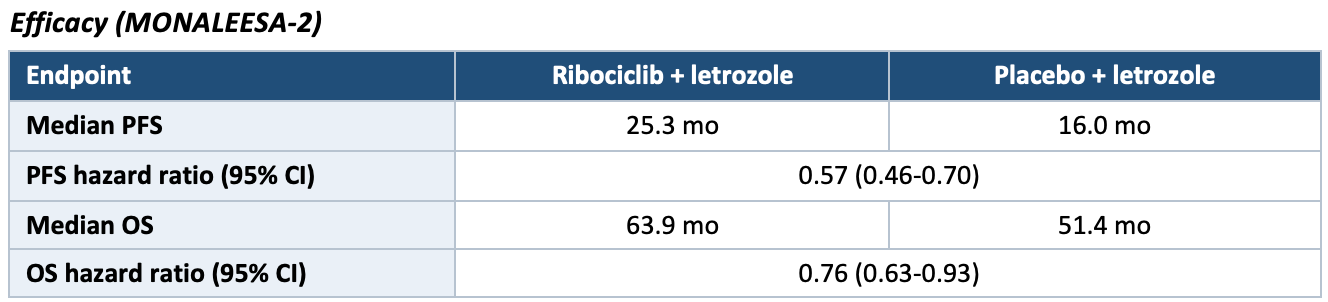
- MONALEESA-2 is one of the few first-line CDK4/6 inhibitor trials to demonstrate a statistically significant overall survival benefit. State the follow-up duration alongside these figures on any slide.1,2,3
- Adjuvant setting: the early breast cancer indication rests on NATALEE (NCT03701334), in which 5,101 patients with stage II or III disease received ribociclib 400 mg (21/7) for 3 years plus a nonsteroidal aromatase inhibitor versus the aromatase inhibitor alone, with invasive disease-free survival as the primary endpoint.1
Safety
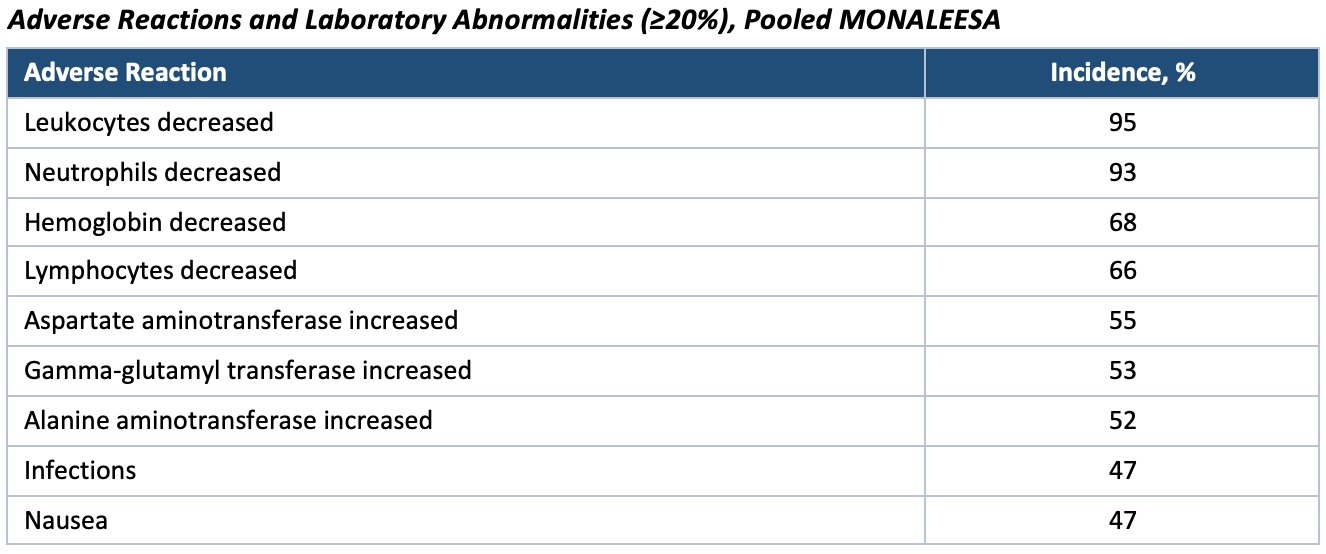
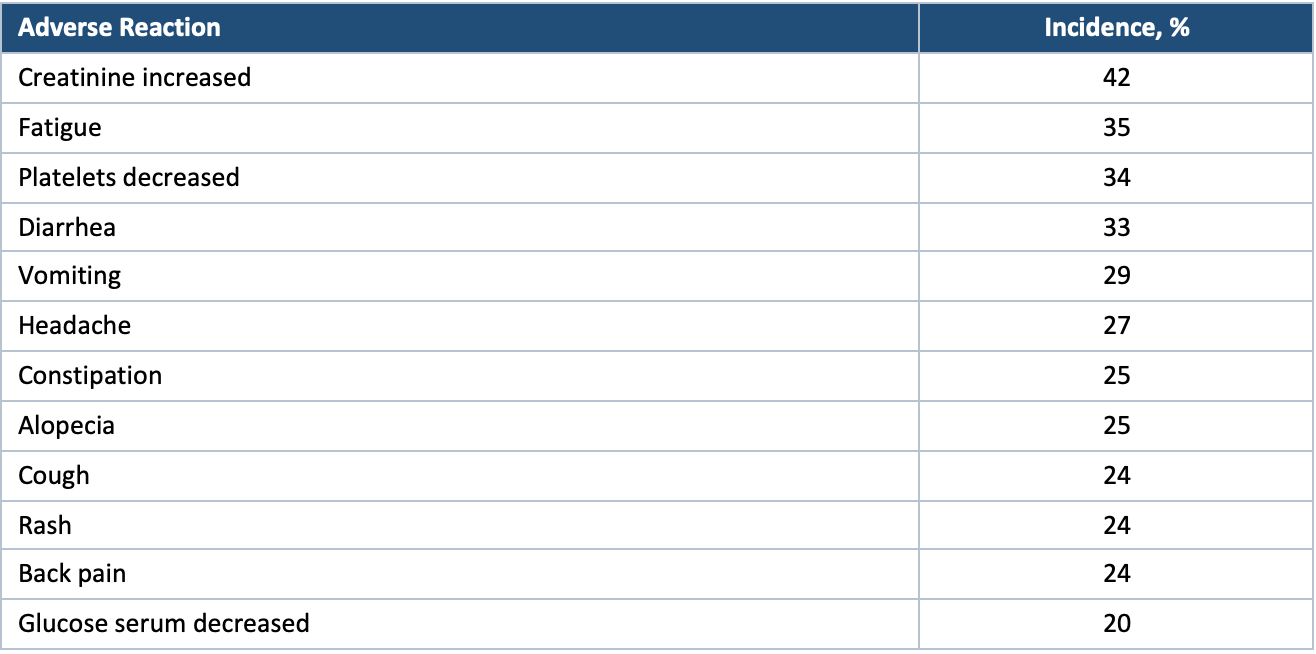
Pooled MONALEESA Population (MONALEESA-2, -3, and -7; N=1,065, 600 mg)
- Population note: the table below is the pooled advanced or metastatic population across three MONALEESA trials at the 600 mg dose. It is not MONALEESA-2 alone, and it does not describe the 400 mg early breast cancer setting.1
- Key warning, QTc prolongation: Among 1,054 patients with advanced or metastatic disease receiving 600 mg, 15 (1.4%) had a post-baseline QTcF above 500 msec and 61 (6%) had an increase from baseline above 60 msec. Prolongation was reversible with dose interruption and mostly occurred within the first four weeks. Interstitial lung disease or pneumonitis occurred in 1.6%, with 0.4% Grade 3-4 and 0.1% fatal.1
- Early breast cancer (NATALEE, 400 mg): the adjuvant population has a distinct and lower cardiac and pulmonary risk profile. Among 2,494 patients, 8 (0.3%) had a post-baseline QTcF above 500 msec and 50 (2%) had an increase above 60 msec, with no reported Torsades de Pointes; 1.5% had Grade 1-2 interstitial lung disease or pneumonitis. Do not apply the 600 mg rates to the adjuvant setting.1
References
1. KISQALI (ribociclib) tablets. Prescribing information. Novartis Pharmaceuticals Corporation. Accessed July 2026.
2. Hortobagyi GN, Stemmer SM, Burris HA, et al. Ribociclib as first-line therapy for HR-positive, advanced breast cancer (MONALEESA-2). N Engl J Med. 2016;375(18):1738-1748. doi:10.1056/NEJMoa1609709
3. Hortobagyi GN, Stemmer SM, Burris HA, et al. Overall survival with ribociclib plus letrozole in advanced breast cancer. N Engl J Med. 2022;386(10):942-950. doi:10.1056/NEJMoa2114663