Brand: Ibrance
Initial US Approval
- 20151
Indications
- In combination with an aromatase inhibitor as initial endocrine-based therapy, or with fulvestrant in patients with disease progression following endocrine therapy, for adults with hormone receptor (HR)-positive, HER2-negative advanced or metastatic breast cancer.1
- In combination with inavolisib and fulvestrant for adults with endocrine-resistant, PIK3CA-mutated, HR-positive, HER2-negative locally advanced or metastatic breast cancer, as detected by an FDA-approved test, following recurrence on or after completing adjuvant endocrine therapy.1
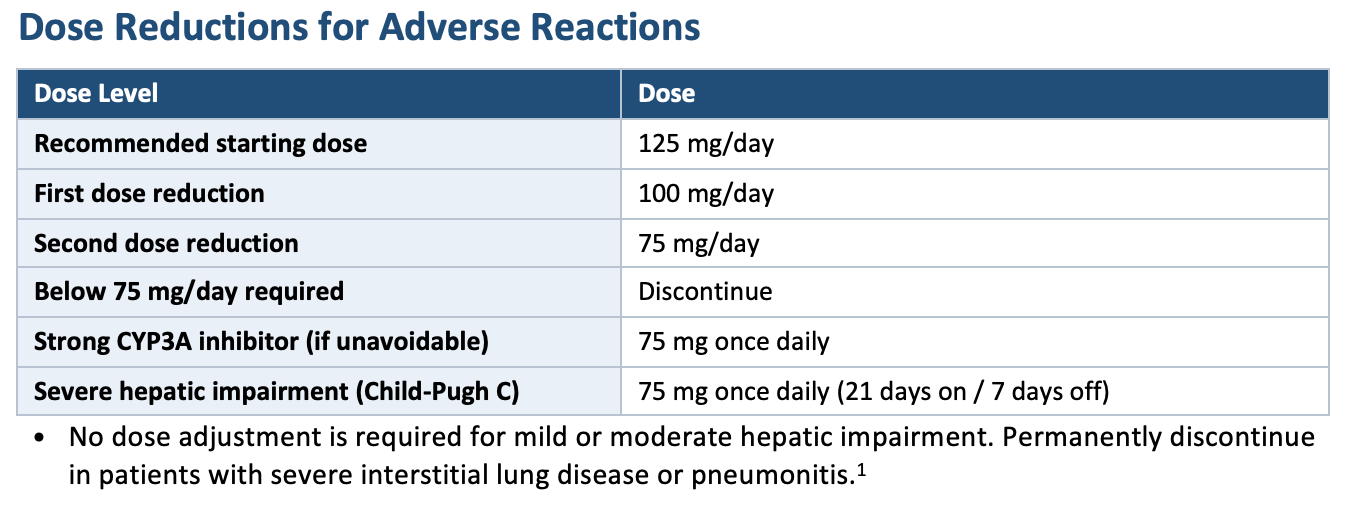
Recommended Dose/Route
- 125 mg orally once daily for 21 consecutive days followed by 7 days off, comprising a complete cycle of 28 days. Tablets may be taken with or without food; capsules are taken with food.1
- Swallow tablets whole; do not chew, crush, or split. If a dose is vomited or missed, take the next prescribed dose at the usual time rather than an additional dose.1
- Pre- and perimenopausal women should also receive an LHRH agonist. When given with fulvestrant, the fulvestrant dose is 500 mg on Days 1, 15, 29, and once monthly thereafter.1
- Monitor complete blood counts before starting, at the beginning of each cycle, on Day 15 of the first 2 cycles, and as clinically indicated.1
Pivotal Study
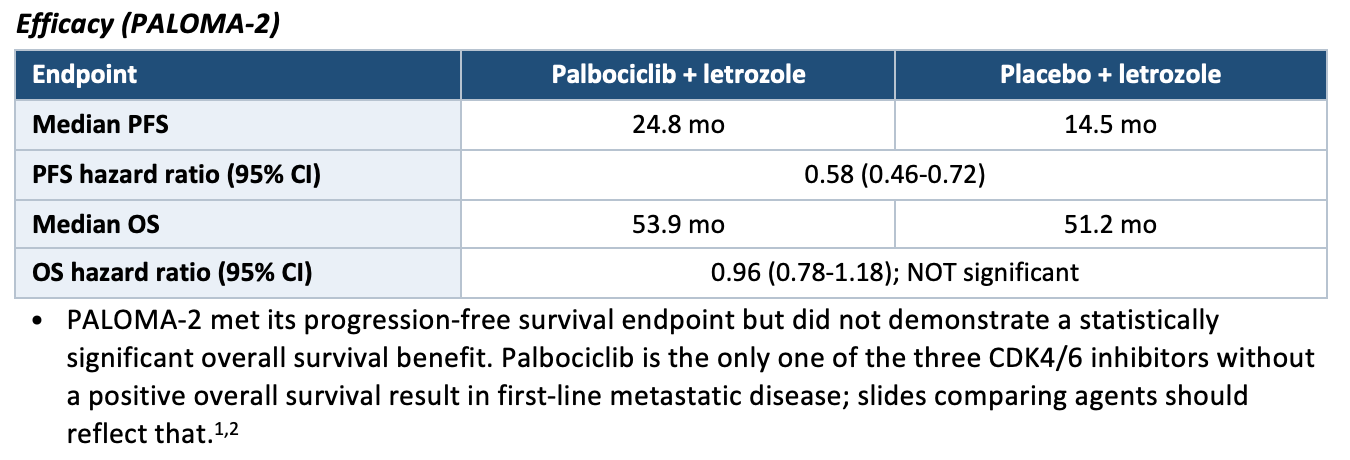
PALOMA-2 (NCT01740427)
- Key Inclusion Criteria: Postmenopausal women with ER-positive/HER2-negative advanced or metastatic breast cancer receiving initial endocrine-based therapy.1,2
- Treatment: Palbociclib 125 mg/day (21/7) plus letrozole 2.5 mg/day versus placebo plus letrozole; 444 of 666 patients received at least one dose of palbociclib. Median duration of treatment 19.8 months versus 13.8 months.1
Safety
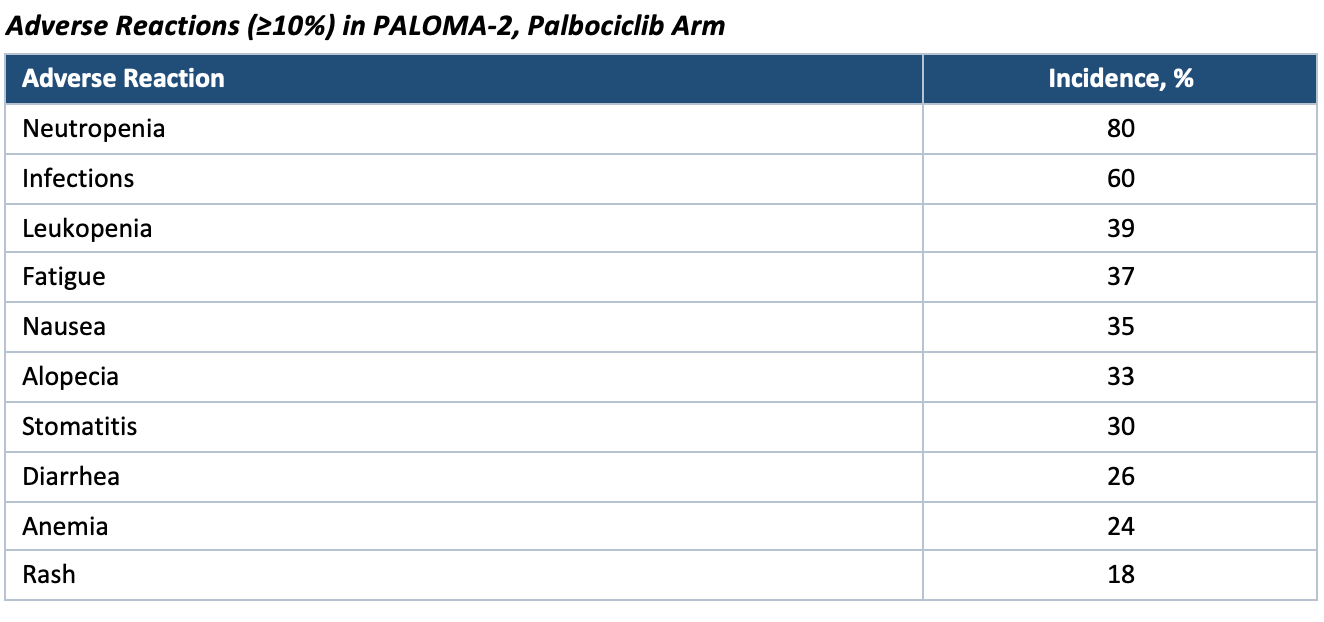
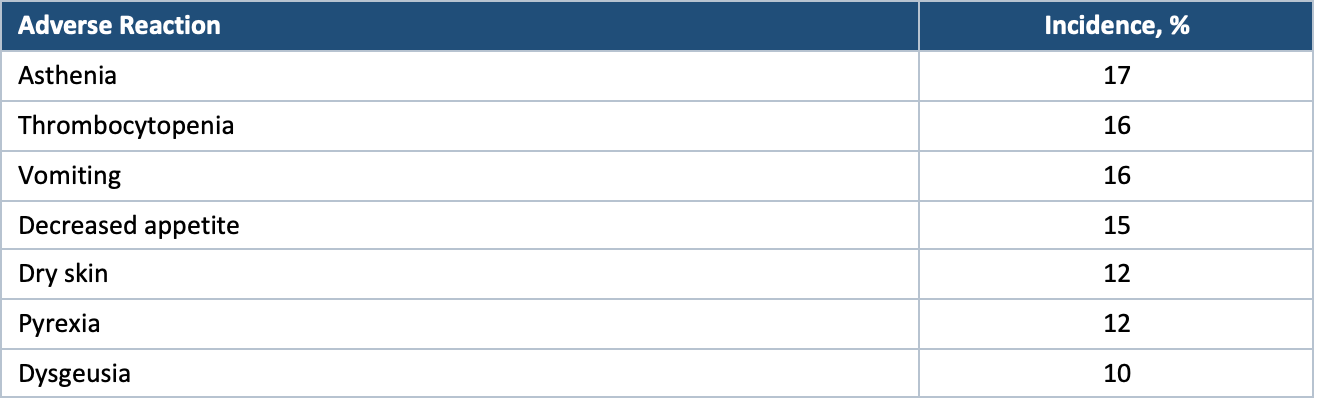
PALOMA-2 (palbociclib plus letrozole; N=444)
- Summary: Dose reductions due to an adverse reaction occurred in 36% of patients. Permanent discontinuation associated with an adverse reaction occurred in 10% versus 6% with placebo, most commonly for neutropenia (1.1%) and increased ALT (0.7%). The most frequent Grade 3 or higher reactions at 5% or higher were neutropenia, leukopenia, infections, and anemia.1
- Key warning, neutropenia: Neutropenia was the most frequently reported adverse reaction, at 80% in PALOMA-2 and 83% in PALOMA-3, with Grade 3 or higher decreases in neutrophil count in 66% of patients in each trial. Median time to first any-grade episode was 15 days and median duration of Grade 3 or higher neutropenia was 7 days. Febrile neutropenia occurred in 1.8% of patients across PALOMA-2 and PALOMA-3 combined.1
- Laboratory abnormalities: decreased white blood cells (97%), increased creatinine (96%), decreased neutrophils (95%), decreased hemoglobin (78%), decreased platelets (63%), increased AST (52%), and increased ALT (43%). Grade 3 or 4 abnormalities were substantial, with neutrophils decreased Grade 3 in 56% and Grade 4 in 12%.1
- Triplet regimen: with inavolisib and fulvestrant (INAVO120, N=162), serious adverse reactions occurred in 24%, fatal reactions in 3.7%, permanent discontinuation in 4.9%, dose reduction in 38%, and interruption in 71%. Stomatitis (51%) and diarrhea (48%) are far higher than with palbociclib plus letrozole; do not substitute PALOMA-2 rates for this regimen.1
References
1. IBRANCE (palbociclib) tablets. Prescribing information. Pfizer Laboratories Div Pfizer Inc; revised 9/2025. Accessed July 2026.
2. Finn RS, Martin M, Rugo HS, et al. Palbociclib and letrozole in advanced breast cancer (PALOMA-2). N Engl J Med. 2016;375(20):1925-1936. doi:10.1056/NEJMoa1607303