Initial US Approval
20171
- The adjuvant indication originally required a Ki-67 score of 20% or higher. That requirement was removed in March 2023 and Ki-67 must not appear in indication statements.1
Indications
- In combination with endocrine therapy (tamoxifen or an aromatase inhibitor) for the adjuvant treatment of adults with HR-positive, HER2-negative, node-positive early breast cancer at high risk of recurrence.1
- In combination with an aromatase inhibitor as initial endocrine-based therapy for adults with HR-positive, HER2-negative advanced or metastatic breast cancer.1
- In combination with fulvestrant for adults with HR-positive, HER2-negative advanced or metastatic breast cancer with disease progression following endocrine therapy.1
- As monotherapy for adults with HR-positive, HER2-negative advanced or metastatic breast cancer with disease progression following endocrine therapy and prior chemotherapy in the metastatic setting.1
Recommended Dose/Route
- 150 mg orally twice daily in combination with endocrine therapy, or 200 mg twice daily as monotherapy, taken continuously with or without food.1
- Unlike palbociclib and ribociclib, abemaciclib is dosed continuously rather than 21 days on and 7 days off.1
- Early breast cancer: continue for 2 years, or until recurrence or unacceptable toxicity. Advanced disease: continue until progression or unacceptable toxicity.1
- At the first sign of loose stools, start an antidiarrheal such as loperamide, increase oral fluids, and notify the care team. Monitor complete blood counts and liver function tests before starting, every 2 weeks for the first 2 months, monthly for the next 2 months, and as clinically indicated.1
- Abemaciclib causes a benign increase in serum creatinine by inhibiting the renal transporters OCT2, MATE1, and MATE2-K, without affecting glomerular filtration. Consider BUN, cystatin C, or a non-creatinine-based GFR to assess true renal function.1
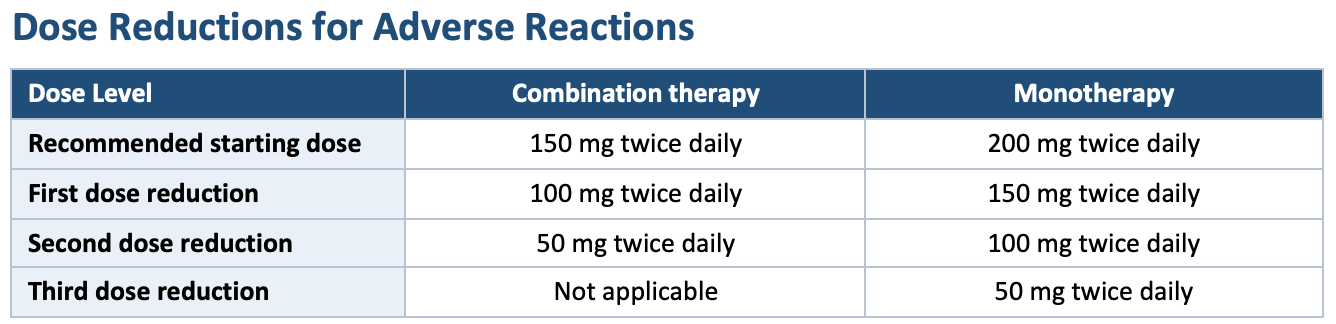
- Discontinue for patients unable to tolerate 50 mg twice daily. The two ladders differ: from the 200 mg monotherapy starting dose the first reduction is 150 mg, not 100 mg, and there are three reduction steps rather than two.1
- Interactions and hepatic impairment: avoid ketoconazole entirely. With other strong CYP3A inhibitors, reduce to 100 mg twice daily. For severe hepatic impairment (Child-Pugh C), reduce dosing frequency to once daily.1
Pivotal Study
MONARCH 3 (NCT02246621)
- Key Inclusion Criteria: Postmenopausal women with HR-positive/HER2-negative locoregionally recurrent or metastatic breast cancer and no prior systemic therapy in this disease setting.1,2
- Treatment: Abemaciclib 150 mg twice daily or placebo, plus physician's choice of anastrozole or letrozole once daily. Safety population 327 abemaciclib versus 161 placebo.1
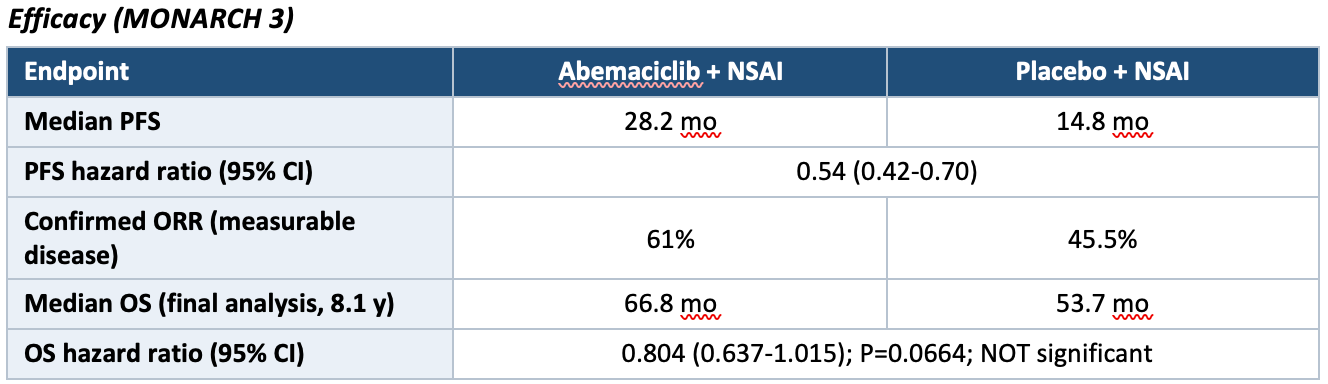
- MONARCH 3 met its primary progression-free survival endpoint, but overall survival was a gated secondary endpoint and did not reach statistical significance at final analysis after 8.1 years, despite a numerical difference of 13.1 months. State the negative OS result alongside the PFS result.3
- Analysis note: the 28.2-month median and hazard ratio 0.54 are from the registrational analysis. The 8.1-year analysis reported median PFS of 29.0 versus 14.8 months (HR 0.535). Use one analysis consistently.2,3
- Adjuvant setting: the early breast cancer indication rests on monarchE (NCT03155997), in which 5,637 patients with node-positive, high-risk disease received 2 years of abemaciclib plus standard endocrine therapy versus endocrine therapy alone, with invasive disease-free survival as the primary endpoint.1
Safety
MONARCH 3 (first-line metastatic; N=327)
- Summary: Deaths during treatment or 30-day follow-up regardless of causality occurred in 3% versus 2% with placebo. Permanent discontinuation occurred in 13% versus 3%, dose interruption in 56%, and dose reduction in 43%. The most frequent Grade 3-4 reactions at 5% or higher were neutropenia, diarrhea, leukopenia, increased ALT, and anemia.1
- Key warning, diarrhea: Diarrhea is the characteristic and dose-limiting toxicity, occurring in 81% to 90% of patients across four trials, Grade 3 in 8% to 20%, with median time to first onset of 6 to 8 days.1
- Other labeled risks: neutropenia including fatal neutropenic sepsis; interstitial lung disease or pneumonitis (3.3% any grade, 0.6% Grade 3-4, 0.4% fatal in the advanced population); hepatotoxicity; venous thromboembolism (5% in MONARCH 3 versus 0.6% with placebo); and embryo-fetal toxicity.1
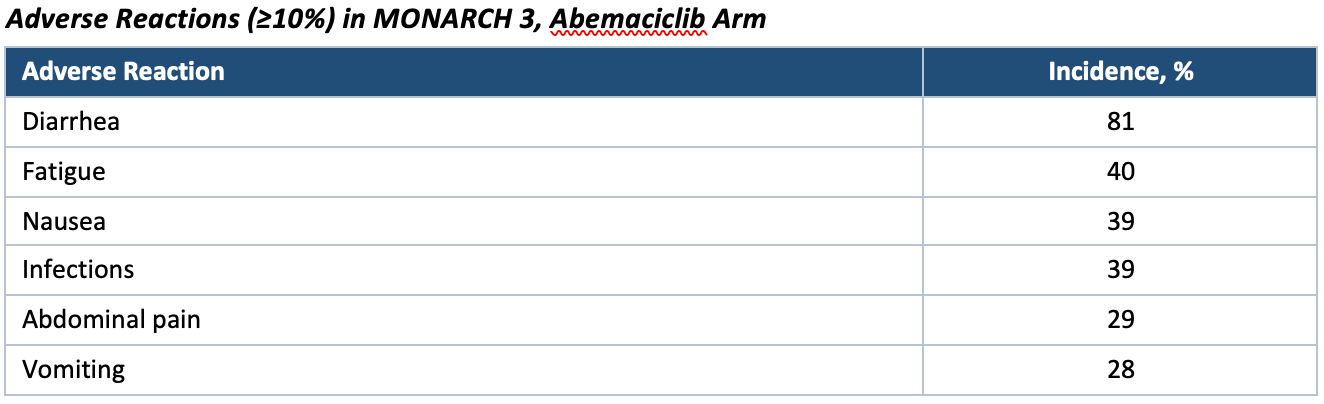
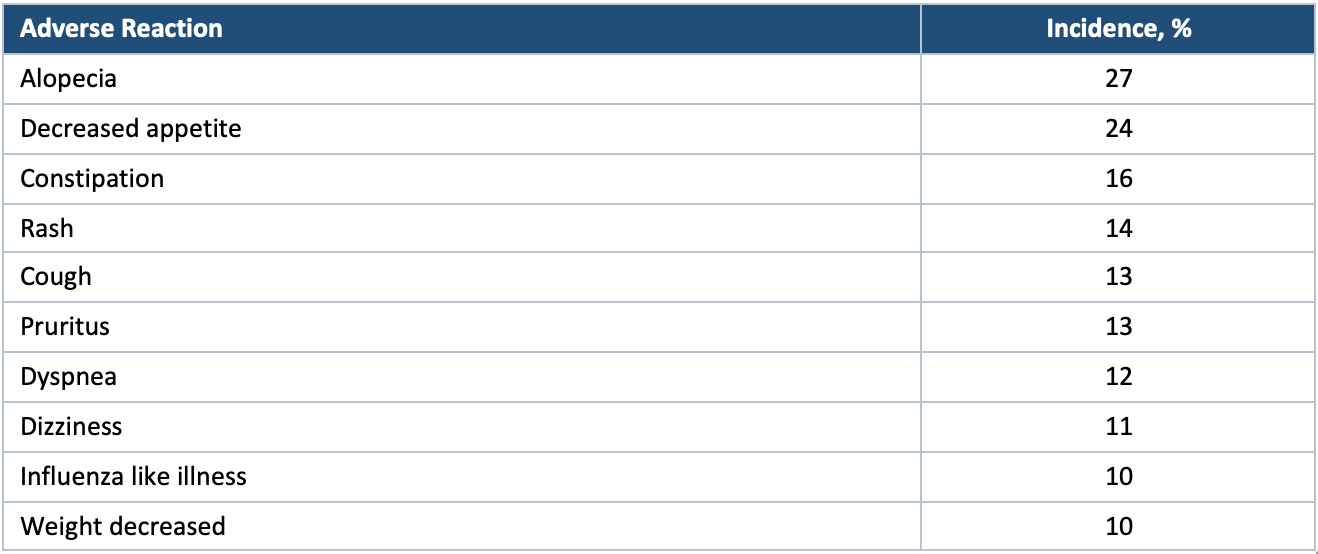
- Laboratory abnormalities: increased creatinine (98%), decreased white blood cells (82%), anemia (82%), decreased neutrophils (80%), decreased lymphocytes (53%), increased ALT (48%), increased AST (37%), and decreased platelets (36%). A slide showing only the clinical adverse reaction table understates the hematologic profile.1
- Adjuvant setting (monarchE, N=2,791): fatal adverse reactions 0.8%, permanent discontinuation 19%, dose interruption 62%, dose reduction 44%. Diarrhea occurred in 84%, infections in 51%, and fatigue in 41%. Do not apply metastatic rates to the adjuvant setting or vice versa.1
References
1. VERZENIO (abemaciclib) tablets. Prescribing information. Eli Lilly and Company; revised 7/2026. Accessed July 2026.
2. Goetz MP, Toi M, Campone M, et al. MONARCH 3: abemaciclib as initial therapy for advanced breast cancer. J Clin Oncol. 2017;35(32):3638-3646. doi:10.1200/JCO.2017.75.6155
3. Goetz MP, Toi M, Huober J, et al. Abemaciclib plus a nonsteroidal aromatase inhibitor as initial therapy for HR+, HER2- advanced breast cancer: final overall survival results of MONARCH 3. Ann Oncol. 2024. doi:10.1016/j.annonc.2024.04.013