Brand: Talzenna
Initial US Approval
- 20181
Indications
- Adults with deleterious or suspected deleterious germline BRCA-mutated (gBRCAm), HER2-negative locally advanced or metastatic breast cancer. Patients must be selected for therapy based on an FDA-approved companion diagnostic (BRACAnalysis CDx), performed on germline DNA.1,3
- Talazoparib has no approved adjuvant breast cancer indication; the breast label is confined to locally advanced or metastatic disease. A separate indication in HRR gene-mutated metastatic castration-resistant prostate cancer, in combination with enzalutamide, uses a different starting dose and is outside the scope of this page.1
Recommended Dose/Route
- 1 mg orally once daily, with or without food, until disease progression or unacceptable toxicity. Capsules are supplied as 0.1 mg, 0.25 mg, 0.35 mg, 0.5 mg, 0.75 mg, and 1 mg to support dose modification.1
- Swallow capsules whole; do not open or dissolve.1
- Withhold until patients have adequately recovered from hematologic toxicity caused by previous therapy before initiating treatment. Monitor complete blood counts monthly during treatment.1
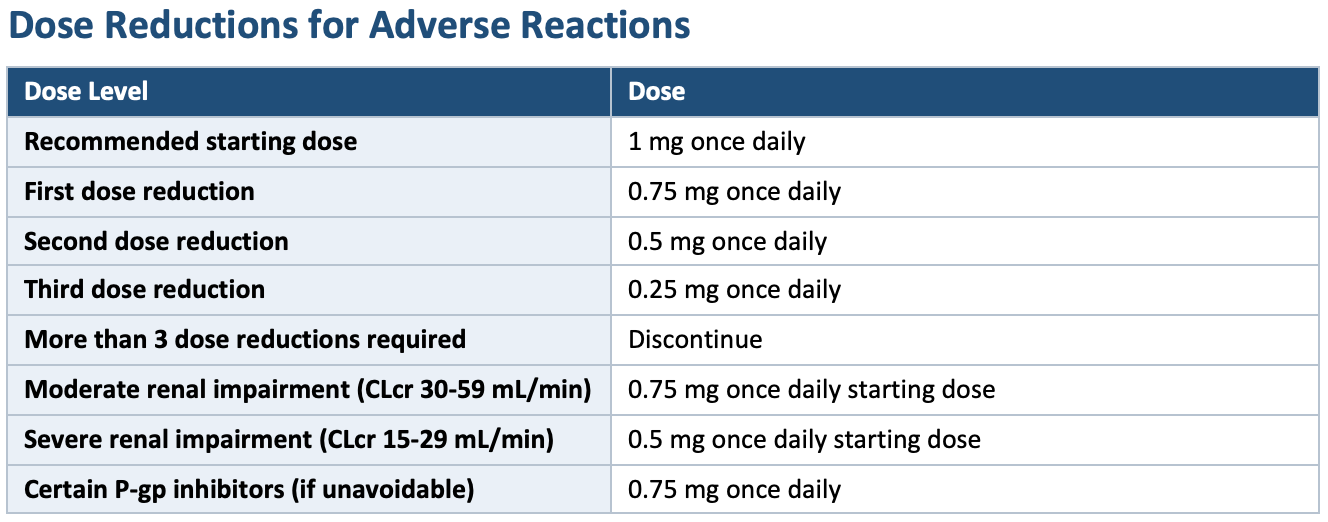
- Withhold for hemoglobin below 8 g/dL, platelet count below 50,000/microliter, or neutrophil count below 1,000/microliter, and resume at a reduced dose once levels recover. For non-hematologic Grade 3 or 4 reactions, withhold until Grade 1 or lower, then resume at a reduced dose or discontinue. No dosage modification is recommended for hepatic impairment.1
Pivotal Study
EMBRACA (NCT01945775)
- Key Inclusion Criteria: Adults with deleterious or suspected deleterious germline BRCA-mutated, HER2-negative locally advanced or metastatic breast cancer who had received no more than three prior cytotoxic chemotherapy regimens for advanced disease. Patients were required to have received an anthracycline and/or a taxane, unless contraindicated, in the neoadjuvant, adjuvant, and/or metastatic setting. Germline BRCA status was confirmed by BRACAnalysis CDx.1,2
- Treatment: 431 patients randomized 2:1 to talazoparib 1 mg once daily (n=287) or physician's choice of single-agent chemotherapy (capecitabine, eribulin, gemcitabine, or vinorelbine; n=144), until disease progression or unacceptable toxicity.1,2
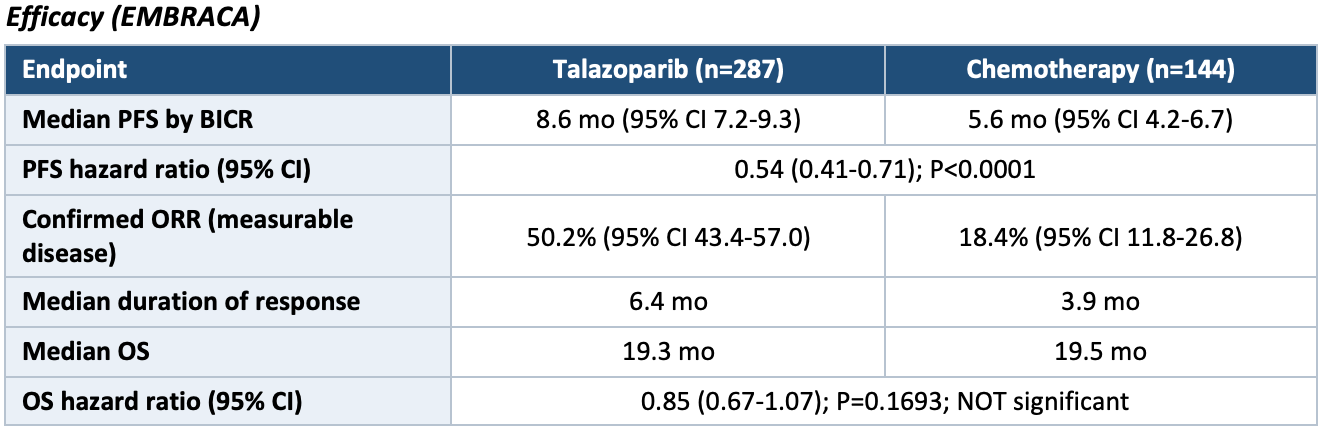
- Progression-free survival results were consistent across the subgroups defined by the study stratification factors: prior lines of chemotherapy for metastatic disease, triple-negative versus non-triple-negative status, and history of CNS metastases. Overall survival was a secondary endpoint and was not improved, with deaths in 75% of patients in each arm; state this alongside the PFS result on any slide.1
Safety
EMBRACA (N=286)
- Summary: Serious adverse reactions occurred in 32% of patients, those above 2% being anemia (6%) and pyrexia (2%). Fatal adverse reactions occurred in 1%. Permanent discontinuation due to adverse reactions occurred in 5%, dosing interruptions in 65%, and dose reductions in 53%. Median duration of treatment was 6.1 months versus 3.9 months with chemotherapy.1
- Key warnings: myelosuppression is the dose-limiting toxicity. Among patients receiving single-agent talazoparib, Grade 3 or higher anemia, neutropenia, and thrombocytopenia occurred in 39%, 21%, and 15% respectively. MDS/AML was reported in 0.4% of solid tumor patients treated with single-agent talazoparib, and some cases were fatal. Embryo-fetal toxicity also applies.1
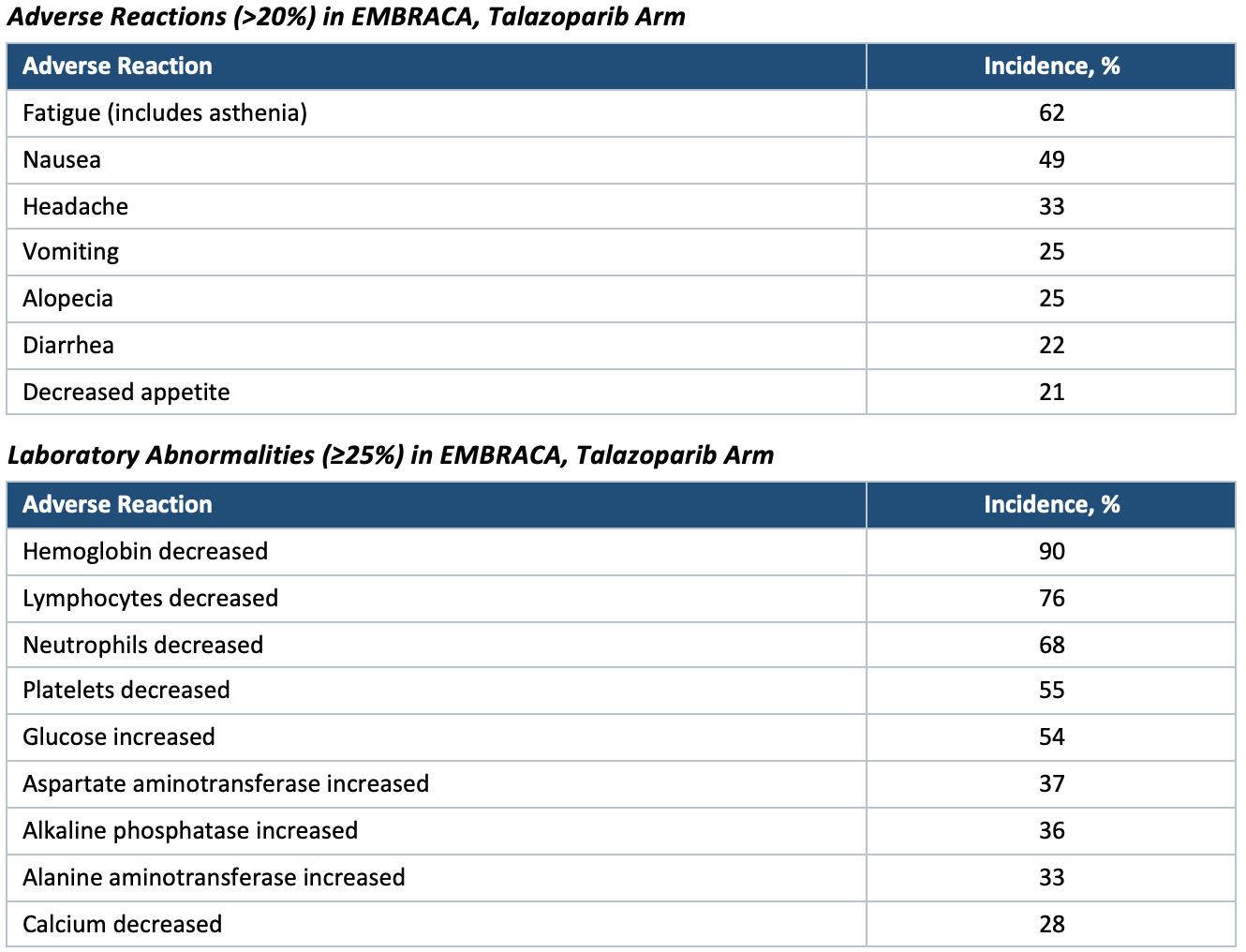
- Myelosuppression appears in the laboratory table rather than as clinical adverse reaction terms; Grade 3 rates were 39% for hemoglobin decreased, 17% each for lymphocytes and neutrophils decreased, and 11% for platelets decreased. A slide showing only the clinical adverse reaction table understates the myelosuppression profile of this drug.1
References
1. TALZENNA (talazoparib) capsules. Prescribing information. Pfizer Inc. Accessed July 2026.
2. Litton JK, Rugo HS, Ettl J, et al. Talazoparib in patients with advanced breast cancer and a germline BRCA mutation (EMBRACA). N Engl J Med. 2018;379(8):753-763. doi:10.1056/NEJMoa1802905
3. US Food and Drug Administration. FDA approves talazoparib for gBRCAm HER2-negative locally advanced or metastatic breast cancer. October 16, 2018. Accessed July 2026.