Brand: Tukysa
Initial US Approval
- 20201
Indications
- In combination with trastuzumab and capecitabine for the treatment of adults with advanced unresectable or metastatic HER2-positive breast cancer, including patients with brain metastases, who have received one or more prior anti-HER2-based regimens in the metastatic setting.1,2
Recommended Dose/Route
- 300 mg orally twice daily, with or without food, in combination with trastuzumab and capecitabine, until disease progression or unacceptable toxicity. Swallow tablets whole; do not chew, crush, or split.1
- Capecitabine is given at 1,000 mg/m2 orally twice daily on Days 1 to 14 of each 21-day cycle. Trastuzumab is given per its standard schedule.1
- Assess liver function tests before starting, every 3 weeks during treatment, and as clinically indicated.1
Dose Reductions for Adverse Reactions
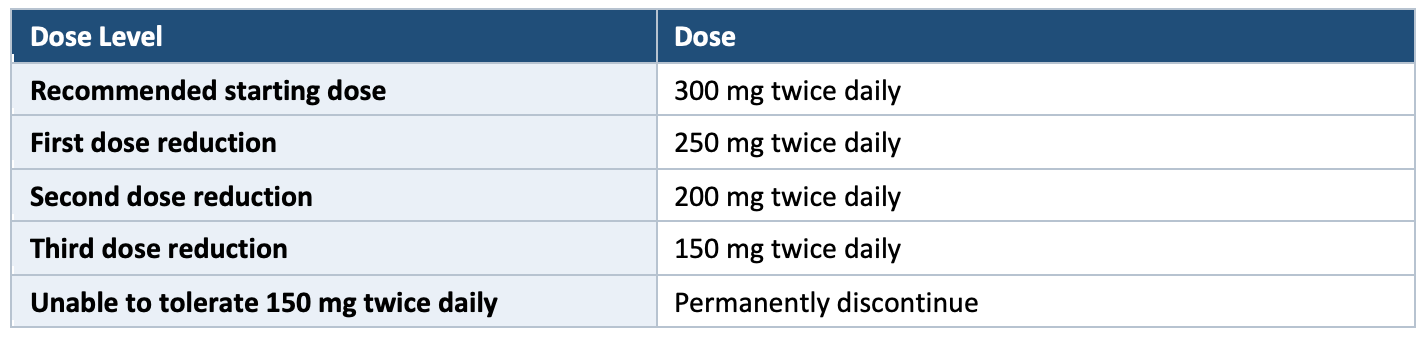
- Reduce the dose to 150 mg twice daily in patients with severe hepatic impairment (Child-Pugh C). Avoid concomitant strong CYP3A or moderate CYP2C8 inducers and strong CYP2C8 inhibitors.1
Pivotal Study
HER2CLIMB (NCT02614794)
- Key Inclusion Criteria: HER2-positive metastatic breast cancer previously treated with trastuzumab, pertuzumab, and ado-trastuzumab emtansine. Notably, the trial enrolled patients with previously treated stable brain metastases, previously treated progressing brain metastases, and untreated brain metastases; 612 patients randomized, of whom approximately 48% had brain metastases at baseline.1,2
- Treatment: Tucatinib 300 mg twice daily plus trastuzumab and capecitabine versus placebo plus trastuzumab and capecitabine, randomized 2:1.1,2
Efficacy (HER2CLIMB)
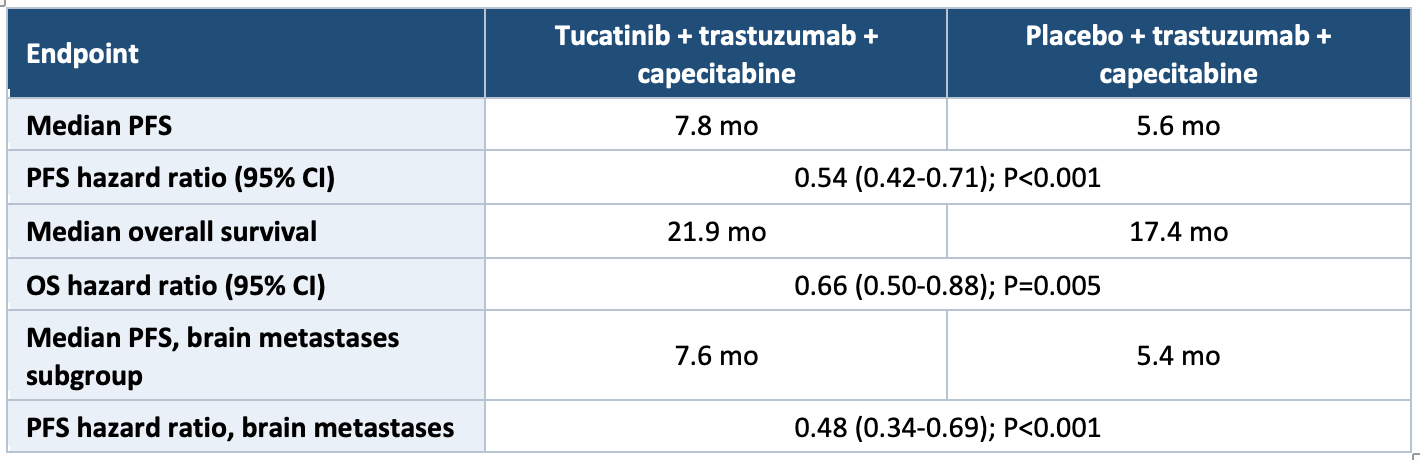
- HER2CLIMB is the registrational trial that specifically enrolled patients with active and untreated brain metastases and demonstrated intracranial benefit, which is why the indication explicitly names patients with brain metastases. This distinguishes tucatinib from other HER2-directed agents whose CNS data are retrospective or subgroup-derived.1,2
Safety
- Common adverse reactions: diarrhea, palmar-plantar erythrodysesthesia, nausea, fatigue, hepatotoxicity, vomiting, stomatitis, decreased appetite, abdominal pain, headache, anemia, and rash.1
- Key warning, diarrhea: diarrhea is the most frequent adverse reaction and can be severe, with cases of dehydration, hypotension, acute kidney injury, and death reported. Antidiarrheal treatment should be started at onset as clinically indicated; prophylaxis is not required, in contrast to neratinib.1
- Hepatotoxicity: elevations in ALT, AST, and bilirubin occurred. Monitor liver function tests before starting, every 3 weeks during treatment, and as clinically indicated, with dose modification for Grade 3 or higher elevations.1
- Because tucatinib is highly HER2-selective with minimal EGFR inhibition, rates of EGFR-type toxicity such as rash are lower than with the less selective pan-HER inhibitors.1
References
- TUKYSA (tucatinib) tablets. Prescribing information. Seagen Inc. Accessed August 2026.
- Murthy RK, Loi S, Okines A, et al. Tucatinib, trastuzumab, and capecitabine for HER2-positive metastatic breast cancer (HER2CLIMB). N Engl J Med. 2020;382(7):597-609. doi:10.1056/NEJMoa1914609