Brand: Herceptin
Initial US Approval
- 19981
Indications
- Adjuvant treatment of HER2-overexpressing node-positive or node-negative (ER/PR-negative or with one high-risk feature) breast cancer, as part of a regimen with doxorubicin, cyclophosphamide, and either paclitaxel or docetaxel; with docetaxel and carboplatin; or as a single agent following multi-modality anthracycline-based therapy.1
- In combination with paclitaxel for first-line treatment of HER2-overexpressing metastatic breast cancer, and as a single agent for patients who have received one or more chemotherapy regimens for metastatic disease.1,2
- Select patients based on HER2 protein overexpression or HER2 gene amplification determined by an FDA-approved test.1
Recommended Dose/Route
- Metastatic: initial dose 4 mg/kg by intravenous infusion over 90 minutes, then 2 mg/kg weekly over 30 minutes until disease progression.1
- Adjuvant: initial dose 4 mg/kg over 90 minutes then 2 mg/kg weekly during chemotherapy for the first 12 weeks or 18 weeks; or 8 mg/kg over 90 minutes then 6 mg/kg every 3 weeks. Complete a total of 52 weeks of therapy.1
- Do not substitute HERCEPTIN for or with ado-trastuzumab emtansine or fam-trastuzumab deruxtecan. Trastuzumab biosimilars and the subcutaneous coformulation with hyaluronidase are separate products with distinct dosing.1
- Assess left ventricular ejection fraction before initiation, every 3 months during and on completion of treatment, and every 6 months for at least 2 years following completion as a component of adjuvant therapy.1
Dose Modification
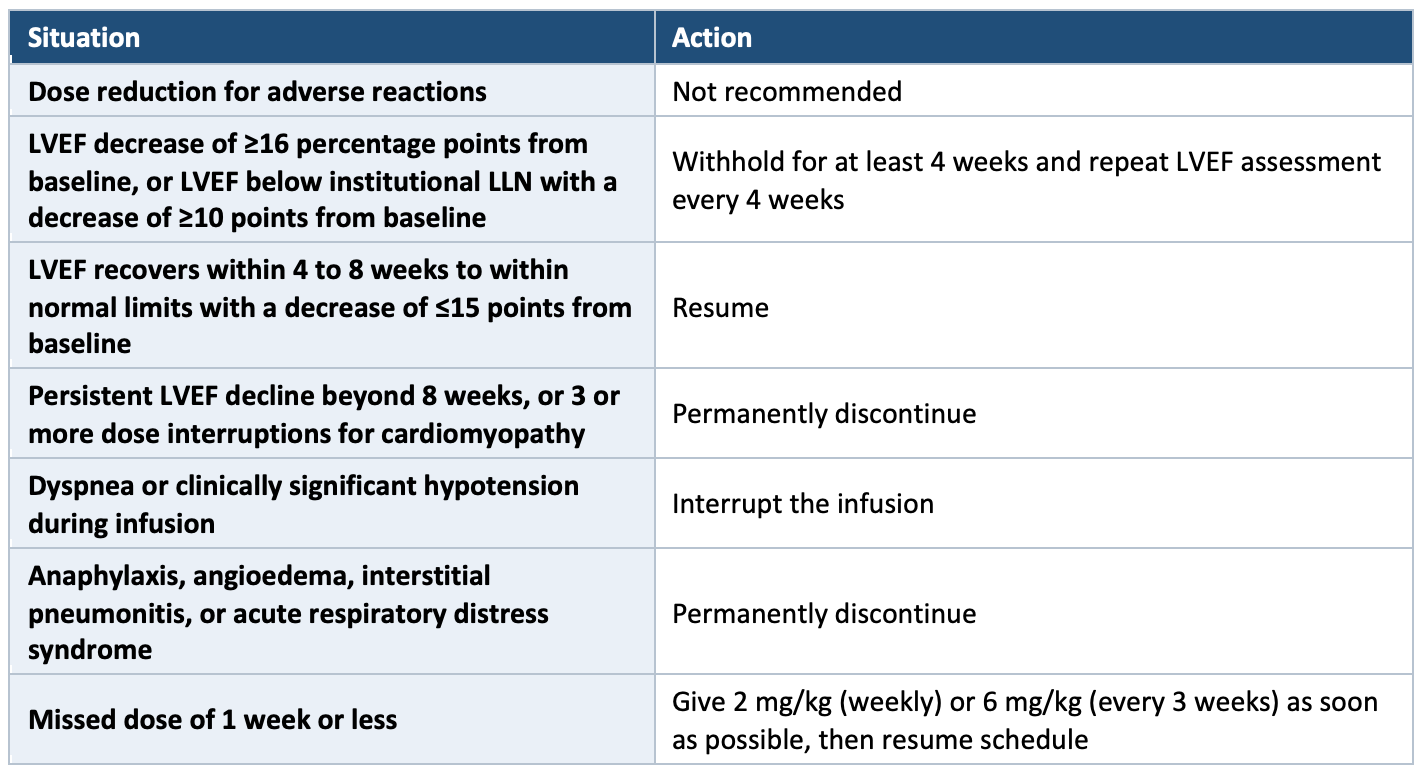
- No dose reductions of HERCEPTIN are recommended. Adverse reactions are managed by withholding or discontinuing.1
Pivotal Study
NSABP B-31 and NCCTG N9831 (integrated analysis)
- Key Inclusion Criteria: Women with breast tumors showing HER2 overexpression (IHC 3+) or gene amplification (FISH), verified centrally or at a reference laboratory. Patients with a history of active cardiac disease or uncontrolled hypertension were not eligible. The DFS analysis population had a median age of 49 years, with 91% nodal involvement, 66% high-grade pathology, and 53% ER-positive and/or PR-positive tumors.1
- Treatment: Randomized 1:1 to doxorubicin and cyclophosphamide followed by paclitaxel (AC to paclitaxel), or the same followed by paclitaxel plus trastuzumab (AC to paclitaxel plus Herceptin). Trastuzumab was given at 4 mg/kg on the day paclitaxel was initiated, then 2 mg/kg weekly for a total of 52 weeks. The joint DFS analysis included 3,752 patients at a median follow-up of 2.0 years; the preplanned final overall survival analysis included 4,063 patients and was performed after 707 deaths at a median follow-up of 8.3 years.1,3,6
Efficacy (NSABP B-31 and NCCTG N9831 Integrated Analysis)

- Overall survival benefit was consistent across subgroups defined by age, hormone receptor status, number of positive lymph nodes, tumor size and grade, and surgery or radiation therapy. Subgroup hazard ratios ranged from 0.52 (tumor 2 cm or smaller) to 0.67 (tumor larger than 2 cm), with age and hormone receptor subgroups all between 0.63 and 0.65.1
- Other adjuvant trials: HERA4 (n=3,386 in the observation and one-year arms) evaluated trastuzumab 8 mg/kg followed by 6 mg/kg every 3 weeks given after completion of definitive surgery and at least four cycles of chemotherapy. A prospectively planned analysis at a median 8 years found that extending treatment to two years provided no additional benefit over one year (DFS HR 0.99, 95% CI 0.87-1.13, P=0.90; OS HR 0.98, 95% CI 0.83-1.15, P=0.78), which is the basis for the 52-week treatment duration. BCIRG 006 (n=3,222) evaluated a non-anthracycline docetaxel and carboplatin plus trastuzumab regimen.1,5
- The metastatic indication rests on a separate randomized trial of chemotherapy with or without trastuzumab in previously untreated HER2-overexpressing metastatic disease. Trastuzumab is the foundational HER2-directed agent and the comparator or backbone for essentially all subsequent HER2 regimens.1,2
Safety
- Common adverse reactions: in the adjuvant setting, headache, diarrhea, nausea, and chills. In the metastatic setting, fever, chills, headache, infection, congestive heart failure, insomnia, cough, and rash.1
- Key warnings: cardiomyopathy, infusion reactions, embryo-fetal toxicity, and pulmonary toxicity, all carried in the boxed warning. Exacerbation of chemotherapy-induced neutropenia has also been observed.1
- Cardiac dysfunction risk is highest with concurrent or prior anthracycline exposure and is the reason left ventricular ejection fraction monitoring is mandated before and throughout treatment. Trastuzumab was permanently discontinued in trial patients who developed congestive heart failure or persistent or recurrent LVEF decline. Cardiomyopathy incidence rates by trial and regimen are tabulated in prescribing information section 6.1 and should be sourced there rather than from trial publications.1
References
- HERCEPTIN (trastuzumab) for injection. Prescribing information. Genentech, Inc. Accessed August 2026.
- Slamon DJ, Leyland-Jones B, Shak S, et al. Use of chemotherapy plus a monoclonal antibody against HER2 for metastatic breast cancer that overexpresses HER2. N Engl J Med. 2001;344(11):783-792. doi:10.1056/NEJM200103153441101
- Romond EH, Perez EA, Bryant J, et al. Trastuzumab plus adjuvant chemotherapy for operable HER2-positive breast cancer. N Engl J Med. 2005;353(16):1673-1684. doi:10.1056/NEJMoa052122
- Piccart-Gebhart MJ, Procter M, Leyland-Jones B, et al. Trastuzumab after adjuvant chemotherapy in HER2-positive breast cancer. N Engl J Med. 2005;353(16):1659-1672. doi:10.1056/NEJMoa052306
- Slamon D, Eiermann W, Robert N, et al. Adjuvant trastuzumab in HER2-positive breast cancer. N Engl J Med. 2011;365(14):1273-1283. doi:10.1056/NEJMoa0910383
- Perez EA, Romond EH, Suman VJ, et al. Trastuzumab plus adjuvant chemotherapy for HER2-positive breast cancer: planned joint analysis of overall survival from NSABP B-31 and NCCTG N9831. J Clin Oncol. 2014;32(33):3744-3752. doi:10.1200/JCO.2014.55.5730