Brand: Perjeta
Initial US Approval
- 20121
Indications
- In combination with trastuzumab and docetaxel for the treatment of patients with HER2-positive metastatic breast cancer who have not received prior anti-HER2 therapy or chemotherapy for metastatic disease.1
- In combination with trastuzumab and chemotherapy for the neoadjuvant treatment of patients with HER2-positive, locally advanced, inflammatory, or early-stage breast cancer (either greater than 2 cm in diameter or node-positive) as part of a complete treatment regimen for early breast cancer.1
- In combination with trastuzumab and chemotherapy for the adjuvant treatment of patients with HER2-positive early breast cancer at high risk of recurrence.1
- Pertuzumab is also available as a fixed-dose subcutaneous combination with trastuzumab and hyaluronidase, which is a separate product with distinct dosing.1
Recommended Dose/Route
- Initial dose 840 mg by intravenous infusion over 60 minutes, followed every 3 weeks by 420 mg over 30 to 60 minutes, administered in combination with trastuzumab and chemotherapy.1
- Neoadjuvant: administer for 3 to 6 cycles as part of one of several complete regimens. Adjuvant: administer as part of a complete regimen, for a total of up to 1 year (up to 18 cycles) including the neoadjuvant portion.1
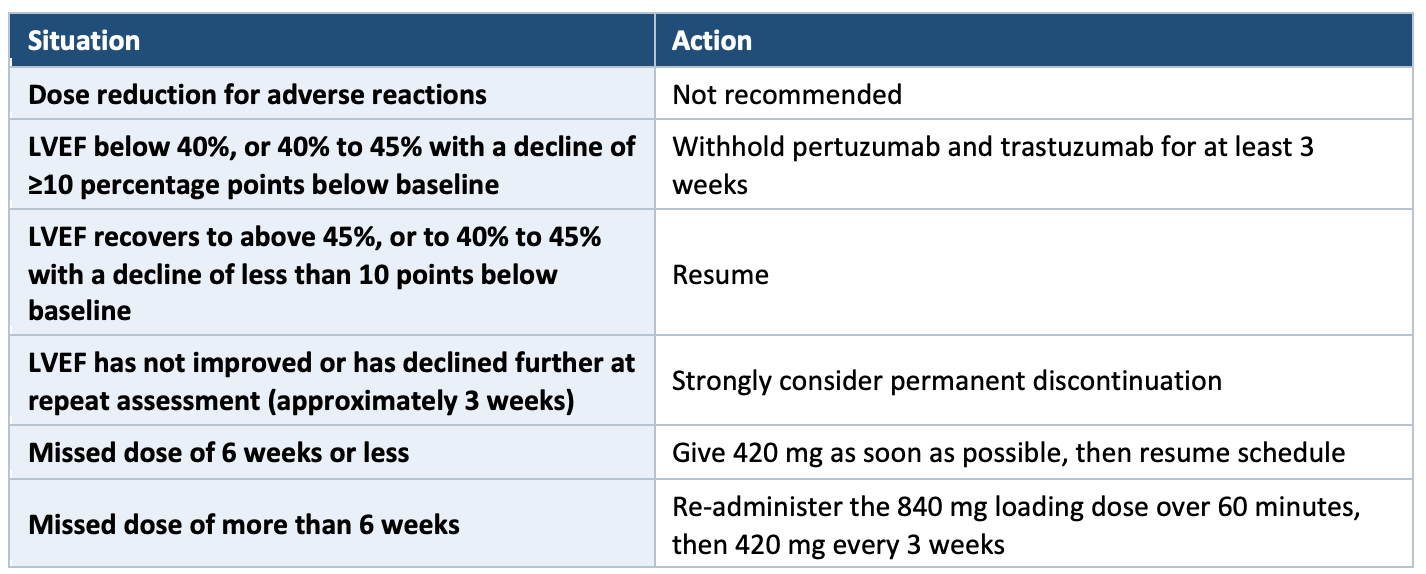
- Assess left ventricular ejection fraction before initiation and at regular intervals during treatment. If a dose of trastuzumab is withheld or discontinued, pertuzumab should also be withheld or discontinued.1
Dose Modification
- No dose reductions of PERJETA are recommended. Adverse reactions are managed by withholding or discontinuing, and pertuzumab is withheld or discontinued whenever trastuzumab is.1
Pivotal Study
CLEOPATRA (NCT00567190)
Key Inclusion Criteria: Patients with HER2-positive metastatic breast cancer who had not received prior anti-HER2 therapy or chemotherapy for metastatic disease; 808 patients randomized.1,2
Treatment: Pertuzumab plus trastuzumab and docetaxel versus placebo plus trastuzumab and docetaxel.1,2
Efficacy (CLEOPATRA)
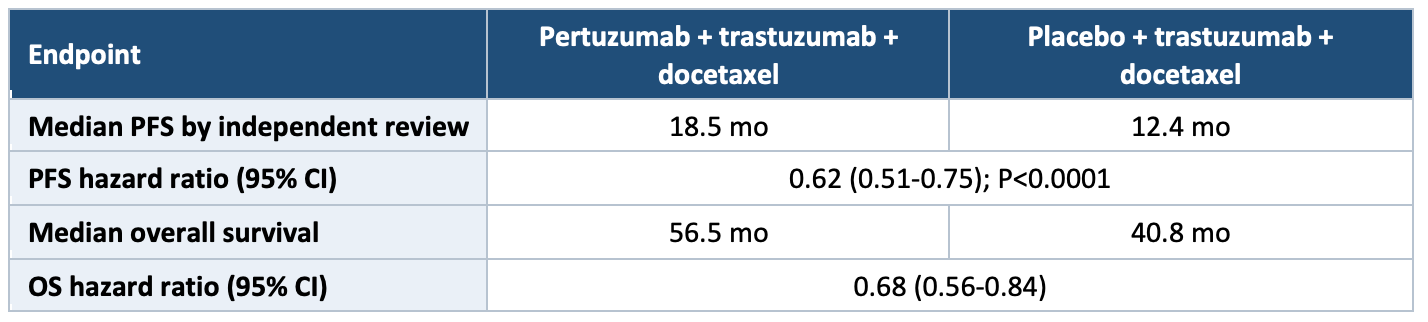
- CLEOPATRA established dual HER2 blockade as first-line standard of care and produced one of the largest overall survival gains recorded in metastatic breast cancer. In the adjuvant APHINITY trial, addition of pertuzumab improved invasive disease-free survival, with benefit concentrated in the node-positive population.1,2
Safety
- Common adverse reactions: in the metastatic setting with trastuzumab and docetaxel, diarrhea, alopecia, neutropenia, nausea, fatigue, rash, and peripheral neuropathy. In the adjuvant setting, diarrhea, nausea, alopecia, fatigue, peripheral neuropathy, and vomiting.1
- Key warnings: cardiomyopathy and embryo-fetal toxicity, both in the boxed warning; plus infusion-related reactions and hypersensitivity including anaphylaxis. Left ventricular dysfunction rates were comparable between arms in CLEOPATRA, indicating pertuzumab did not add materially to trastuzumab cardiac risk in that setting.1
- References
- PERJETA (pertuzumab) injection. Prescribing information. Genentech, Inc. Accessed August 2026.
- Swain SM, Miles D, Kim SB, et al. Pertuzumab, trastuzumab, and docetaxel for HER2-positive metastatic breast cancer (CLEOPATRA): end-of-study results. Lancet Oncol. 2020;21(4):519-530. doi:10.1016/S1470-2045(19)30863-0