Brand: Nerlynx
Initial US Approval
- 20171
Indications
- As a single agent for the extended adjuvant treatment of adults with early-stage HER2-positive breast cancer, following adjuvant trastuzumab-based therapy.1,2
- In combination with capecitabine for adults with advanced or metastatic HER2-positive breast cancer who have received two or more prior anti-HER2-based regimens in the metastatic setting.1,3
Recommended Dose/Route
- 240 mg (six 40 mg tablets) orally once daily with food, at approximately the same time each day. Swallow tablets whole; do not chew, crush, or split.1
- Extended adjuvant: continue for 1 year. With capecitabine: capecitabine 750 mg/m2 twice daily on Days 1 to 14 of each 21-day cycle, continued until disease progression or unacceptable toxicity.1
- Antidiarrheal prophylaxis is mandatory. Administer loperamide with the first dose of neratinib and continue during the first 56 days, then as needed. Dose escalation of neratinib over the first 2 weeks is an alternative strategy shown to reduce diarrhea incidence.1
Dose Reductions for Adverse Reactions
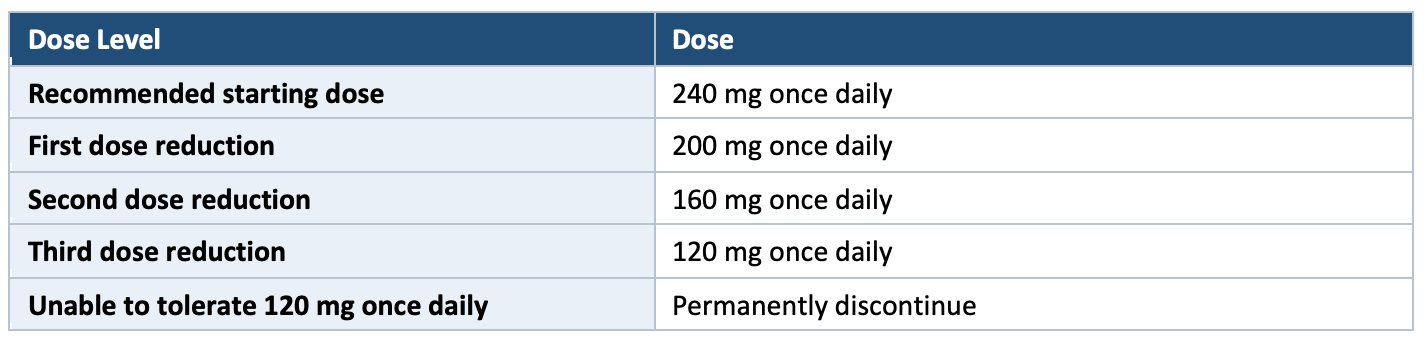
- Reduce the starting dose to 80 mg once daily in patients with severe hepatic impairment (Child-Pugh C). Avoid concomitant proton pump inhibitors, strong or moderate CYP3A4 inhibitors and inducers, and separate H2-receptor antagonists and antacids from neratinib dosing.1
Pivotal Study
ExteNET (NCT00878709)
- Key Inclusion Criteria: Adults with early-stage HER2-positive breast cancer who had completed adjuvant trastuzumab-based therapy within the preceding 2 years; 2,840 patients randomized.1,2
- Treatment: Neratinib 240 mg once daily for 1 year versus placebo.1,2
Efficacy (ExteNET)

- Benefit was concentrated in the hormone receptor-positive subgroup and in patients who started neratinib within one year of completing trastuzumab. In the metastatic setting, the NALA trial supported the capecitabine combination, showing improved progression-free survival versus lapatinib plus capecitabine.1,2,3
Safety
- Key warning, diarrhea: diarrhea occurred in 95% of neratinib-treated patients in ExteNET, with Grade 3 diarrhea in approximately 40% of patients who did not receive prophylaxis. Median time to first onset was within the first few days of treatment. Loperamide prophylaxis during the first 56 days is required, not optional, and is the single most important element of tolerability management for this drug.1,2
- Common adverse reactions: diarrhea, nausea, abdominal pain, fatigue, vomiting, rash, stomatitis, decreased appetite, muscle spasms, dyspepsia, increased AST or ALT, nail disorder, dry skin, abdominal distention, weight decreased, and urinary tract infection.1
- Other labeled risks: hepatotoxicity and embryo-fetal toxicity. Monitor liver function tests monthly for the first 3 months of treatment, then every 3 months, and as clinically indicated.1
References
- NERLYNX (neratinib) tablets. Prescribing information. Puma Biotechnology, Inc. Accessed August 2026.
- Martin M, Holmes FA, Ejlertsen B, et al. Neratinib after trastuzumab-based adjuvant therapy in HER2-positive breast cancer (ExteNET): 5-year analysis. Lancet Oncol. 2017;18(12):1688-1700. doi:10.1016/S1470-2045(17)30717-9
- Saura C, Oliveira M, Feng YH, et al. Neratinib plus capecitabine versus lapatinib plus capecitabine in HER2-positive metastatic breast cancer (NALA). J Clin Oncol. 2020;38(27):3138-3149. doi:10.1200/JCO.20.00147