Brand: Tykerb
Initial US Approval
- 20071
Indications
- In combination with capecitabine for the treatment of patients with advanced or metastatic HER2-positive breast cancer who have received prior therapy including an anthracycline, a taxane, and trastuzumab.1
- In combination with letrozole for the treatment of postmenopausal women with hormone receptor-positive, HER2-positive metastatic breast cancer for whom hormonal therapy is indicated.1
- Lapatinib has largely been superseded in practice by tucatinib, neratinib, and the HER2-directed antibody-drug conjugates, but remains an approved option and a comparator in several registrational trials.1
Recommended Dose/Route
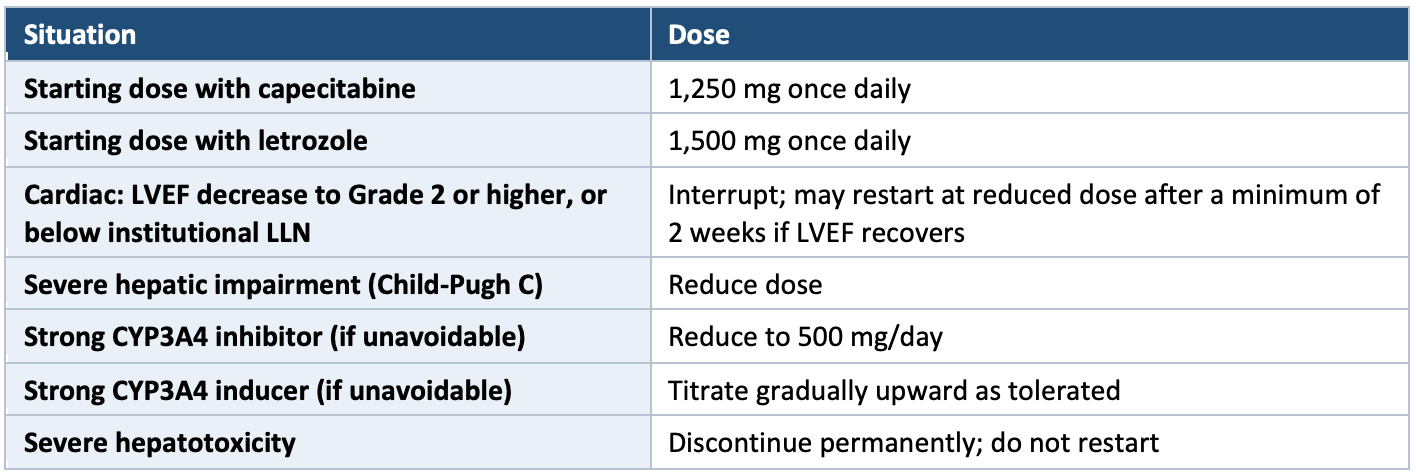
- With capecitabine: 1,250 mg (five 250 mg tablets) orally once daily on Days 1 to 21 continuously, plus capecitabine 2,000 mg/m2/day in two doses approximately 12 hours apart on Days 1 to 14 of a 21-day cycle.1
- With letrozole: 1,500 mg (six 250 mg tablets) orally once daily continuously, plus letrozole 2.5 mg once daily.1
- Administer at least 1 hour before or 1 hour after a meal. Take the total daily dose once daily rather than divided, and avoid grapefruit products.1
- Obtain liver function tests before initiation, every 4 to 6 weeks during treatment, and as clinically indicated. Assess left ventricular ejection fraction before initiation and during treatment.1
Dose Reductions for Adverse Reactions
Pivotal Study
EGF100151 (lapatinib plus capecitabine)
- Key Inclusion Criteria: Patients with HER2-positive locally advanced or metastatic breast cancer progressing after prior therapy including an anthracycline, a taxane, and trastuzumab; 399 patients randomized.1,2
- Treatment: Lapatinib 1,250 mg daily plus capecitabine 2,000 mg/m2/day on Days 1 to 14 of a 21-day cycle, versus capecitabine 2,500 mg/m2/day alone.1,2

- The separate EGF30008 trial supported the letrozole combination in hormone receptor-positive, HER2-positive metastatic disease. Confirm both sets of figures against TYKERB prescribing information section 14 before publication.1,2
Safety
- Common adverse reactions with capecitabine: diarrhea, palmar-plantar erythrodysesthesia, nausea, rash, vomiting, and fatigue.1
- Common adverse reactions with letrozole: diarrhea, rash, nausea, fatigue, alopecia, pruritus, anorexia, and vomiting.1
- Key warning, hepatotoxicity: severe hepatotoxicity, including fatal cases, is the basis for the boxed warning. Monitor liver function tests before treatment, every 4 to 6 weeks during treatment, and as clinically indicated. Discontinue permanently and do not restart in patients with severe changes in liver function.1
- Other labeled risks: decreased left ventricular ejection fraction, interstitial lung disease and pneumonitis, QT interval prolongation, severe cutaneous reactions, diarrhea including severe cases, and embryo-fetal toxicity. As a dual HER2/EGFR inhibitor, lapatinib produces more EGFR-type toxicity (rash, diarrhea) than the HER2-selective tucatinib.1
References
- TYKERB (lapatinib) tablets. Prescribing information. Novartis Pharmaceuticals Corporation. Accessed August 2026.
- Geyer CE, Forster J, Lindquist D, et al. Lapatinib plus capecitabine for HER2-positive advanced breast cancer. N Engl J Med. 2006;355(26):2733-2743. doi:10.1056/NEJMoa064320